Notice...

The purpose of this blog is to have a little fun. It is NOT to start arguments. I don't profess to be an expert on Sci-fi, nor do I aspire to become an expert. You are welcome to comment on any and all content you find here. If my opinion differs from yours, as far as I am concerned, it's all okay. I will never say that you are wrong because you disagree with me, and I expect the same from those that comment here. Also, my audience on the blog will include some young people. Please govern your language when posting comments.

Posts will hopefully be regular based on the movies I see, the television shows I watch, and the books I read as well as what ever strikes me as noteworthy.


***SPOILER ALERT***
Spoilers will appear here and are welcome.

Autograph Collecting

Saturday, July 20, 2013

A.I. Revolution or Evolution? - My Review of David Mack's ST: TNG: Cold Equations Book #3 - The Body Electric


Star Trek: TNG: Cold Equations: The Body Electric by David Alan Mack (2012)

This is the third (and final) installment of the Cold Equations trilogy.  This story is set not long after the events that take place in the final Next Generation film, Nemesis.  The main story arch of the three books revolves around a resurrected Data and his efforts to resurrect his daughter Lal.  While the first two books deal with a mostly political plot line in which the Breen are making efforts to usurp power in the Alpha Quadrant, the third book takes a very different direction bringing back Wesley Crusher in his role as a Traveler whose purpose is to save the galaxy itself from extinction.

While traveling the galaxy, Wesley discovers a giant, planet-sized Machine that is destroying star systems and feeding them into the Abaddon super-massive black hole that lies at the center of our galaxy.  When Wes discovers that inhabited systems are being destroyed, he contacts his fellow Travelers to find a way to stop this appalling activity.  The Travelers, who have encountered this phenomena before tell Wes that there is nothing to be done; the galaxy is doomed.  Wes doesn’t accept this assessment and while the rest of the Travelers abandon this galaxy to escape the destruction, Wes turns to the crew of the Enterprise for help.
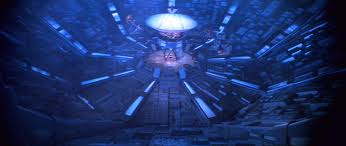
Picard agrees to look into the matter and Wes uses his Traveler skills to transport the Enterprise to the scene.  An away team goes aboard the Machine and learns that the Machine is was built by the same race that enhanced V-Ger (from ST: The Motion Picture).  They also learn that the Machine’s mission is to increase the mass of Abaddon, then crash it into another body called Sagittarius A-Star which will create a wormhole and causing a shockwave that will destroy subspace, thus making warp travel through the galaxy impossible, and eventually would also eradicate all organic life.

Now at the end of the second installment of this series, Data was seeking to make contact with Emil Vaslovik to help him restore Lal, Data’s daughter from TNG.  He discovers that Vaslovik has changed his name to Ahkarin.  At the end of the second novel, Ahkarin had been kidnapped by a rogue faction of the Fellowship of Artificial Intelligences to extract certain cybernetic secrets from him.  Data discovers Ahkarin aboard the AI’s ship as well as Ahkarin’s cybernetic daughter, Rhea.  It also happens that Data is deeply in love with Rhea, so he takes it upon himself to rescue them both.

With Wesley’s help, Data transports onto the Fellowship’s vessel and is incapacitated and imprisoned by the AI leader, Gatt.  Gatt then makes contact with the Machine and decides that his entire crew should up-load their knowledge to the Machine, seeing this as a move toward immortality, even against his crew’s wishes that wish to retain their individuality.

With the help of the Enterprise crew, Data affects an escape from the brig and takes over the AI ship.  He then makes contact with the Machine to try to reason with it, explaining that there is not only will all organic life would be destroyed, but the Machine would also be eradicating all artificial life as well.  The Machine’s response is to determine that the artificial life in our galaxy is unworthy of assimilation and begins sending the AI ship into Abaddon.   Most of the Fellowship members abandon their ship in escape pods.  Included in two separate escape pods are Ahkarin and Rhea.  Data, aboard his sentient ship, uses his tractor beam to attempt to save both Ahkarin and Rhea before they plunge into Abaddon, but he soon learns that he can only save one of them.  Whom he decides to save is a result of the coldest equation of all, does he save the woman he loves, or does he save the one person in the galaxy that can help him bring Lal back from the cascade failure that ended her life?

All through the history of science fiction, writers have speculated on Artificial Intelligence, and our relationship with it.  It is my belief that this day will come sooner rather than later.  In this novel, David Mack explores this in a way that, as far as I know, hasn’t been looked at in depth.  At one point in the book, the author discusses how artificial life might look at us from a philosophical point of view.  In Mack’s estimation, the artificial intelligences of the future would view humanity as nothing more than a step in their own evolution.   I personally would have liked to see the author delve deeper into this existential speculation, as well as how the AI’s might view the Machine as a religious figure.
I enjoyed this book.  However, it was not my favorite of the Cold Equations series.  That honor is reserved for the first of the series.

The three novels in this series include:
#1 – The Persistence of Memory
#2 – Silent Weapons
#3 – The Body Electric

Well, there it is…

QaplaH’

Saturday, July 13, 2013

Pacific Rim - A Lot Like Godzilla -vs- The Transformers - Movie Fun.


Pacific Rim – 2013


I couldn’t get a lot done outside today. So I figured that I would go and take in Pacific Rim this afternoon at the local cinema.  The length of the film is 131 minutes and I must say that it went by very quickly.


A race of monsters known as the Kaiju manage to open a trans-dimensional rift at the bottom of the Pacific Ocean and begin ravaging the costs of the countries that are on the rim of the great ocean.  This, of course, starts a war and the world unites to fight this menace.  It is soon found that no conventional weapons can fight these super monsters, so an armored weapon is developed.


The development results in the Jaegers (German for Hunter).   Jaegers are giant robots that are controlled by two pilots that work in tandem through a neural link; in effect, they are actually in each other’s minds.  At first, the Jaeger program is quite successful in defeating the Kaiju as they are only coming through the rift one at a time.  But the Kaiju are getting more and more powerful as they come through the rift.  The Jaegers suffer more casualties and seem to become less effective and the governments of the Pacific Rim decide to scrap the Jaeger program.  Feeling that the Jaegers are the answer, the commander of the program decides to freelance and moves the program to Hong Kong.
 

A scientist determines the nature of the rift and figures out that it is a wormhole between dimensions and can be closed by the use of a nuclear device.  After several battles with very powerful Kaiju, the hero manages to deliver the nuke into the rift and save mankind from certain destruction.


This film is very predictable as it follows an old formula and tells a story that has been told many times, but it is told very well.   There is no moral to the story, no philosophical rambling, and no political message.  It’s just a fun movie to watch and lose one’s self in.  If you are looking for deep character development, it isn’t here, but it is well acted by the well-directed cast.  The effects and the CGI are top notch and really contributes to how the film flows.  And it flows very smoothly.  It is all topped off by a score that thumps.


Pacific Rim is a great film for what it is, a good diversion on a hot summer day.  It is full of action, fighting, and wrecked buildings.  It doesn’t ask the audience to take it too seriously, and it doesn’t take itself too seriously.  Go see Pacific Rim, you won’t have to think, just enjoy.


Well, there it is…


QaplaH’!

Wednesday, July 10, 2013

The Red Planet Made Green - Review of Green Mars by Kim Stanley Robinson


Green Mars by Kim Stanley Robinson (1994)


At the end of Red Mars, the first of the trilogy, after the revolution of 2061 which resulted in the massive flooding of parts of the planet mars, Green Mars takes the story up some 50 years later with the controversial terraforming of Mars continuing apace.  The flooding of 2061 found the last of the First One Hundred settlers of mars taking refuge in the underground settlement of Zygote.  The story continues by following the activities of those remaining First One Hundred, their children, and their grandchildren.


While the Transnats (Trans-National Corporations) on Earth continue to try to find ways to exploit the resources of Mars, the people who have moved to, or were born on Mars contemplate their bid for independence as a sovereign planet in the solar system.  As this would be a threat to the planned exploitation of the red planet, they attack the Zygote encampment to re-assert their authority over Mars.  The remaining First One hundred and their offspring move to places of safety, or have their appearances changed to continue to survive.


Meanwhile, back on Earth, a major crisis is taking place as the oceans rise; not because of Global Warming though, but rather as a result of volcanic activity near and around Antarctica that is melting the ice and causing huge icebergs to fall into the ocean.  So not only is there the possibility of another revolution taking place on Mars, but there is also revolution taking place on Earth as people scramble to survive in their rapidly changing environment.


Mars’ continues to change more rapidly than expected because of genetically engineered plant life that is thickening the atmosphere by taking out carbon dioxide and replacing it with oxygen, and the engineers that are working the terraforming machinery are also adding nitrogen to the atmosphere.  Mars’ surface isn’t able to support human life, so people either life underground or in huge tents, either with environmental controls.  Another goal is to warm the planet’s surface through the use of giant orbiting mirrors that focus more sunlight on the surface.


The most interesting aspects of this book though are the interactions between the characters, the philosophical considerations and the political ramifications.  But be warned, this book, as well as the first of the trilogy, Red Mars, are not for the casual reader.  These are difficult books to read in that you actually have to immerse yourself in what you are reading.  Let your mind wander for any short length of time and you will miss something important.  These stories are like a high level jigsaw puzzle, but if a piece is missing, you will never understand the whole picture.


Well written, extremely detailed, well researched, and highly imaginative.  I would recommend this for anyone who loves an intricate tale.


Well, there it is…


QaplaH’!

Friday, July 5, 2013

What Class Are Your Children? - Book Review: Children of the New Era by Meinos Kaen


Children of the New Era (S-Class) by Meinos Kaen - 2012

Not long ago, I acquired a new Twitter follower, one Meinos Kaen.  In one of his posts, I noticed that he is an author and was promoting a book called Children of the New Era.  Well, since I am a reader who enjoys reading new stuff, I checked it out on Amazon.com, found that it was available for the Kindle, and the .99 cent price was right so I downloaded it and forgot that I had bought it because I was in the middle of another very long novel.  This morning, I was checking my library and found it and thought I should give it a try, and I am glad that I did.

This story is set in a dystopian distant future.  It takes the form of several blog posts on a fictitious blog called The Proud Parents Blog.   On this blog, parents write in about their gifted, or un-gifted children.  The gifts the children have are not seen now, because this is after “DHE,” or the “Day Humanity Evolved.”  This evolution takes place in many different ways including high mental functioning, enhanced physical abilities, telepathy, and the most dreaded skills held by the S-Class children, or the ability to harm others with thought.

Naturally, the children of the S-Class are eagerly sought by the government’s Home Department.  Many parents take their children to Evaluation Centers to be tested for their abilities, and one is found to be of the S-Class, they are removed from their homes to facilitate further training.  It is presumed that these children are taken by the military for obvious reasons.

In the story, the Home Department shuts down the Proud Parents Blog when they discover that parents are talking about their S-Class children and how they are taken away never to be seen again.
What appeals to me most about this book is the format.  I have never seen a story told almost entirely in the form of blog posts and responses to those posts.  I found it innovative and fresh.

This book is very short, one can read it in about two hours or less, and at the price of $1.99, it’s worth a look.  Actually, this would seem to be a preamble and prequel to a new novel entitled S-Class which is promised for release later this year.  It is well written and quite articulate.  If there is a criticism, it is that Kaen writes the blog’s responses almost  too well; meaning that the characters that are responding to the blog are too intelligent, but this only helps to make the story more concise.

The last part of the book, a chapter titled “???” is a preview of the upcoming novel.

I did enjoy this short story and am looking forward to the release of S-Class.

Podcast News

Following the second episode of Under the Dome on CBS, Wayne Henderson and Troy Heinritz released their latest review on UnderTheDomeRadio.com.  Wayne and Troy give you reviews, news, observations, and listener feedback on episode 2 of the television series entitled “Fire.”  And if you watched that episode on July 3rd, 2013, you will have been introduced to a new character named Randolph, one of the policemen in the town of Chester’s Mill.  Troy and Wayne made a great catch and was able to secure an interview with Kevin Sizemore, the actor that portrays Randolph.  It is a great interview and you can get some good insight on his take on his character and the show in general.  Click HERE to listen on the UTDR website or download from numerous sources like iTunes. 

Scott and Miles at the Scifi Diner Podcast released an episode that is full of news goodness.  They announce some upcoming shows including a Man of Steel show and a Rewind of Jurassic Park.  Also there is a new trivia question that will allow one to win a signed print of Rob Paulsen, a voice actor from Teenage Mutant Ninja Turtles, Animaniacs, and Transformers and others.  They also present an interview with Paulsen.  Miles presents his This Week In Star Trek on the real life tricorder prize of one-million dollars to the first who invents it.  There is also discussion of Man of Steel, Independence Day sequels amd more.  Click HERE to listen to Episode 177 of the Diner.

On Starbase 66, Rick and his crew tackle a load of listener feedback on Episode 125.

I have also recently subscribed to Hank Davis’ Falling skies podcast, but haven’t had a chance to listen yet.  But I know Hank is doing a fine job and I will report when I get caught up.

Well, there it is…

QaplaH’!