Notice...

The purpose of this blog is to have a little fun. It is NOT to start arguments. I don't profess to be an expert on Sci-fi, nor do I aspire to become an expert. You are welcome to comment on any and all content you find here. If my opinion differs from yours, as far as I am concerned, it's all okay. I will never say that you are wrong because you disagree with me, and I expect the same from those that comment here. Also, my audience on the blog will include some young people. Please govern your language when posting comments.

Posts will hopefully be regular based on the movies I see, the television shows I watch, and the books I read as well as what ever strikes me as noteworthy.


***SPOILER ALERT***
Spoilers will appear here and are welcome.

Autograph Collecting

Showing posts with label Tabletop Games. Show all posts

Wednesday, June 6, 2018

Terraforming Mars - A Tabletop Game That Is Stimulating And Fun!

Terraforming Mars

I wasn’t in the market for a new board game when I learned about Terraforming Mars from an ad on Facebook, but the title got my attention. My curiosity led me to look up a video on YouTube about the game and I decided to get it. Fortunately, the local game store had a copy on the shelf. I almost passed on the game when I saw the price was $70, but I bit the bullet and bought it anyway. Since then, I have played the game numerous times and am enjoying it more each time I can get a game in.

Terraforming Mars is a tabletop board game in which the goal is to make the Red Planet habitable to human life. The concept is that Earth has become so overpopulated that resources are running out. Humans are moving out into the solar system to find and adapt new places to live. Mars is one possible candidate planet for this purpose, but there are many obstacles to overcome as one might imagine. First, Mars is very cold and inhospitable to human life. As far as we know, there is no life on Mars, and evidence that there once may have been, liquid water on the planet. Lastly, there is no oxygen in the Martian atmosphere. So therefore, the object of the game is to raise the temperature (to a maximum of +8°c, or 46°F), the atmospheric oxygen content (up to 14%), and surface water to levels that would make the planet marginally habitable. To win the game, one amasses the most points in the form of a “Terraformer Rating.” The game accommodates from one to five players.

Upon opening the box, there doesn’t appear to be much. There is a game board, a lot of cards, numerous markers of various kinds and colors, individual larger cards to keep track of resources, tiles to represent cities, forest, and water, and the instruction book. The box is oversized and there are numerous plastic ziplock bags included to keep everything in order when storing the game.

Along with the  colored player markers with which a player keeps track of various parameters, there are markers that represent currency in the form of Mega Credits, or M€ for short. These consist of large gold, medium sized chrome, and small copper colored cubes that are used to purchase various cards or actions. These are replenished during the game. Other markers keep track of oxygen, temperature and what generation the game is in as time goes on.

There are three different kinds of action cards involved in the game which include event cards that when played, cause something to happen such as the landing of an asteroid, which will cause the temperature to rise on the planet. There are effect/action cards that allow a player to gain benefits when certain conditions are met. Finally there are the automated cards that can also provide benefits. The cards cost various amounts of M€ to play depending on how a player benefits from using them, so the more benefit, the more the expense.

Each player also receives a player board to keep track of their resources as the game goes. There are also corporate cards that give a player their starting M€ amounts and corporate cards that are strictly for beginning players which are not to be used by more experienced players.

The game is played in four phases. Phase one is the player order phase in which a marker is placed before the first player. That person will be the first to play during the action phase. Second is the research phase, in which all players are dealt four cards and they choose which ones they want to play. In the action phase, players take turns playing cards or performing actions until they are no longer able to do so, or until they so choose not to perform actions. When all the players in the game have passed, players enter the production phase in which they collect their earned M€ to begin the next generation.

In my experience playing Terraforming Mars, it is almost intimidating at how complex the game can seem to someone who is just beginning to learn. There is a steep learning curve to this game, but once one begins to understand how it works, it is a really very simple game.  There are a lot of small details to be learned in how to use the cards properly, but again, once a person has a grasp of the game, it gets simpler and one can concentrate more on their strategy as opposed to the rules. If one is considering getting Terraforming Mars, I recommend watching some of the videos available on YouTube that will help flatten some of the learning curve involved. I found five that were particularly helpful, all recorded by Michael on his YouTube channel, “Toucan Play That Game.” Click HERE to access all five of the videos including an unboxing of the game, a game overview, two of the game being played, and finally Michael’s review of Terraforming Mars.

What I like about Terraforming Mars:

According to the box, it should take between 90 minutes to two-hours to get through a game. I have yet to play a game that has lasted less than three hours. As a matter of fact, Chrissy and I recently played a game that was just short of four hours long. So, as one can see, it takes both a time commitment and a lot of patience to play, especially when one is a beginner. This is a great game when the weather is bad, or if one just wants to spend some time with friends or family. There is a mild sense of intensity to this game and while it may seem that it would take a long time to get through, the hours seem to pass rather quickly. I would imagine that more experienced players can cut down on the time factor.

The other reason that this game appeals to me is that once the basic gameplay is understood, a player can really ramp up the strategy that can be involved with scoring the most points. Many of the cards involved in the game work well with other cards, and figuring out what those combinations are is a challenge. As an educator, I love the way this game tends to exercise a player’s abstract thinking skills. Along with card combinations, there are ways to lay the tiles on the board that will also net one points, or cost points to one's opponent. This aspect of the game is not obvious and requires a player to have imagination and to think ahead. So while one is having fun playing the game, one is also getting some brain exercise.

The downside of Terraforming Mars:

What I disliked about the game has nothing to do with the gameplay as much as it is with the packaging of the product. When one open the box, there are a lot of pieces that have to be stored and there is no way to organize those components. It takes a long time to set up the game and the table becomes quite cluttered with parts. It is also quite inconvenient when something is out of the reach of players at different ends of the table. The game comes with several small zip-lock bags to store the components in along with the game board, instructions, cards, and a set of larger cards to keep track of resource. One problem is that if someone accidentally bumps their own or another’s resource card, the markers on those cards can go careening everywhere. It would be virtually impossible for a player to remember where their markers would actually go if they become misplaced. Fortunately, if one is willing to invest more money in the game, there is a solution.

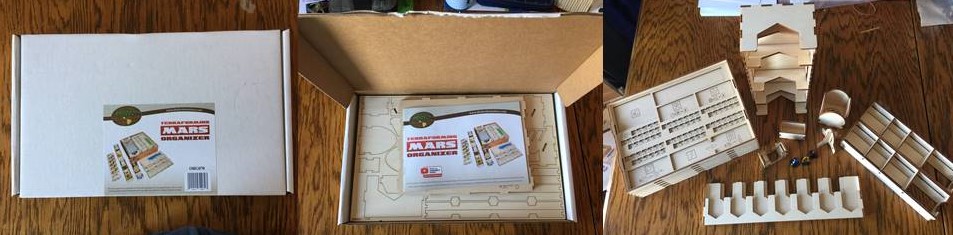
While searching for videos to learn to play Terraforming Mars, I found that there are also several sets of accessories that one might use to solve the problems. The one I purchased is a complete Terraforming Mars organization system that has many advantages. The Terraforming Mars Organizer from The Broken Token company includes a set of twelve trays that organize all of the game components. What’s more, the twelve trays fit perfectly in the Terraforming Mars box. It is a bit pricey at $50 (when ordered directly from the maker, otherwise, the price varies), but well worth the money if one plays the game with any frequency. When the organizer arrives, it comes in a box with several laser cut wood sheets and an instruction sheet. There are also videos available that show step-by-step how to build the various pieces and how they are placed in the Terraforming Mars box.  I built my kit using the videos. It took me about three hours to assemble the kit using wood glue and a small lightweight hammer to make sure all the pieces fi


In my humble opinion, this organizer is great because it allows for really fast setup of the game. It also keeps everything organized and makes it convenient for players at both ends of the table to reach markers quickly. It also eliminates the possibility of ruining a game by accidentally bumping and misplacing markers on the resource card. There are other organizers and accessories to go with Terraforming Mars available for less, but I like the complete organizer from Broken Token.

This Just In!

I have recently learned that there are expansions to Terraforming Mars. One is a two-sided alternate playing board that has the opposite side of the planet from the one on the original board and another view of mars looking north from the south polar region. These two new game boards offer a few twists from the original, but pretty much the same game. Also available is a variant entitled “Terraforming Mars: Venus Next.” According to what I have learned, it is a companion that is designed to play along with the original set. If that isn’t enough, there will be another expansion called “Prelude” that is also designed to be played along with Terraforming Mars. I think all of the expansions are affordable and I will be ordering them soon.


In any case, whether one chooses to get accessories or not, Terraforming Mars is a fun game that will make one think and is also fun at the same time. Despite a bit of a learning curve to play, I have had many hours of entertainment and fun from this game.

Well, there it is…


Qapla’!

Edited by Benjamin Arrowood

Saturday, February 6, 2016

Fun & Games - A Look At Star Wars: X-Wing And Star Trek: Attack Wing Miniature Games

So what have I gone and gotten myself into now?

A few weeks before Christmas, Bruce Schindler (author of the Dust and Cannibal’s series of SciFi books) was having a book signing event at a local gaming and comic book store, The Troll’s Den. So I thought I would go up there and visit with him and pick up Chrissy’s comic book. My grand daughter, Hannah, was having a sleep-over with Chrissy and I took them along.  While at the store, something really neat happened that has started me on a path that I thought I would never go down, namely miniature tabletop gaming.

I was only planning on being at The Troll’s Den for about an hour or so, but time started stretching on and the girls were getting bored after about fifteen minutes.  One of the people that run the store, Ryan noticed that Chrissy was looking at the Star Wars: X-Wing game ships and asked the girls if they would like to learn how to play the game. Chrissy is always up for something new and Hannah also thought it would be fun, so Ryan got out the store’s demo set and began teaching the girls how to play. He probably spent about two hours with them teaching them the ins and outs of X-Wing and I could see that she was having a lot of fun. Hannah was hanging in there too.

On my previous visits to the Den, I had also noticed that there is a Star Trek version of the X-Wing game that I was thinking about getting into myself. Well, When I asked Chrissy, my resident Star Wars super-fan, how she liked the game, she said that she wanted it.  I told her that I would think about it and we would see. Well, being Christmas was just coming very soon, I grabbed the starter kit for X-Wing off the shelf along with an expansion ship, the Millennium Falcon. And while I was at it, I also grabbed the Star Trek: Attack Wing starter kit along with the USS Defiant and managed to get them to the car without letting the kid know what I had gotten. Both games got wrapped and placed under the tree.

In the days that passed after that first experience, Chrissy and I went up to the Den on several occasions and borrowed the store’s sets and we played the games, again with the help of Ryan, who helped us learn the finer points of the game. On Christmas morning, we unwrapped our games and began playing at home.

STAR WARS: X-WING

Of the two games that we play, X-Wing is the easiest to learn and play. The starter kit comes with an X-Wing fighter and two TIE Fighters, pilot cards, and upgrades. There are also tokens for various features that are available to ships as well as maneuvering dials (which show what moves a ship can make) and maneuvering templates to determine where on the three-foot square playing area a ship is able to move.

After one determines what ships and upgrades to use, based on a limited number of points allowed, the player places their ships in the playing area and tries to move their ships into the most advantageous position to either attack, or avoid being attacked. After each ship has been moved into the planned position, the player then performs an action. Actions include focusing, target locking, or doing extra maneuvers as determined by available tokens or as specified on the selected upgrades.

Next comes the battle phase. Ships within a certain range a may attack opponent’s ships to score damage against them. The attack and the opponent’s defense is determined by the dice. There are hits and critical hits, which can include devastating consequences on a ship, and depending on the actions taken a defender can avoid hits on their ship. Also depending on actions taken and what is on the chosen upgrade cards, the dice can be modified to maximize attack and defense results.

After the attack phase is completed, players clean up any tokens left with a few exceptions and once again plan their moves and the process repeats until one opponent’s ships are all destroyed or until a time limit is reached. In competitive play, there is always a time limit on games. In that case, the winner is determined by how many points each has left.

STAR TREK: ATTACK WING

As mentioned earlier, Attack Wing follows much the same procedure as X-Wing, but there are a few more twists with this game. One additional aspect of this game is the inclusion of a resource that can add to the maneuverability or the power of a ship. When a new resource is introduced to the game, it usually expires after eighteen months and can no longer be used in official competitive play, but can be used in non-official play.

Another difference is that Attack Wing seems to include a lot of scenarios that make the game more challenging. One competitive event that I participated in a while back included an element of a story line from Star Trek: Enterprise taken from the Xindi story arc. In “Temporal Cold War III”, a token is placed in the middle of the play area that represents a Delphic Expanse Sphere. Once at the beginning of each round of play, the Sphere send out a massive gravimetric pulse that causes damage to all ships on the board. Players can either choose to destroy the Sphere before attacking each other, or may ignore the Sphere and do battle while trying to sustain the extra damage from the Sphere along with that  inflicted by their opponent. It was a bit harrowing but it did add a dimension to the game that made it interesting.

There are a lot of other details on both games, many that I am still learning as I play, so instead of going into all of them, I will provide links at the end of this article to allow you to investigate further if interested.

SO, WHAT’S THE POINT?

Well, other than just plain having fun, I am enjoying spending time playing with Chrissy. She is really more into the Star Wars end of things while I am a staunch Trekkie and love the ins and outs of Attack Wing, but we do play both games together. Chrissy wants to compete in the Troll’s Den Store Championship that will take place at the end of February, so we play that a lot so she learns how to fly her ships most effectively.

Another aspect that appeals to me is spending time with people who are of the same mindset as me, which is something that I have been missing. The people I have met while gaming are all good people who are mostly just as geeky as I am, and in some cases even more so. When I am playing, there always seems to be a side conversation about what episodes a particular ship or upgrade card is from. My fellow players are also quite friendly and always willing to help out and offer advice to a novice player, such as myself, and some of that advice has translated into wins in my column.

There are also the aspects of strategy and chance involved. It seems that no matter how well one plans their attack or defense, if the dice are not with you, you are going down in flames.

BE LOGICAL

These games are not like Monopoly where you just buy a box of materials once and use until they wear out. They can become a real investment, both monetarily and time wise. While the starter kits cost between $35-45 in both cases, they do not provide adequate resources to play competitively outside of casual play. There are also numerous expansion packs that include ships and upgrade cards, the cost for these varies starting at $15 and can go as high as $100 for very large ships or space stations. At any rate, one will want to expand, especially if one is considering entering competitive play. Many events require a fleet to be “faction pure.” In other words, a typical fleet might consist of three ships, so if one is playing with the faction pure rule in place, all of the ships and upgrades have to be all Federation, or all Klingon, or all Romulan, or whatever others exist. The Attack Wing starter kit comes with three ships; one Federation, one Klingon, and one Romulan ship which works well for casual play, but to compete, one would need at least two expansion sets from a single faction to compete in some events. At this point, there are three factions in the X-Wing game, they include the Rebels, the Imperials, and Scum and Villainy.

This game, at least for me, is very addictive and I have invested considerable time and resources in getting my Attack Wing collection up to a competitive level. I have also invested a great deal in the care of the materials by purchasing card protectors, binders, binder pages, tackle boxes, totes to keep things organized and safe from damage.
WHAT’S IN THE BOX?

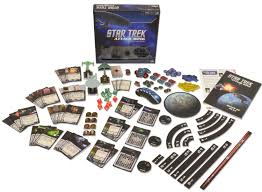
As mentioned earlier, the starter kits include three ship models, plastic stands for the ships, and carious cards that provide personnel and upgrades for the ships. There are also maneuver dials for the planning of movements on the field of battle, gauges for executing planned moves, a range gauge for making attacks, and finally, the attack and defense dice. Along with all of that, there are tokens that represent various aggressive and defensive actions that can alter the outcome of the game.

The models are mostly on the smaller side and are painted to represent the various classes of ships in the universes after which they are modeled. The Attack Wing starter set’s ships are not ass nicely done as the expansion packs, but the X-Wing ships look very authentic in every detail.  Also, the X-Wing ships are far more delicate than their Trek counterparts, and can be easily damaged through mishandling. For instance, the weapons on the X-Wing modes can be easily bent and one has to take great care when mounting them on their stands and making maneuvers with them. If a ship is damaged (one upgrade I purchased had a loose piece that fell of the first time I used it) it can easily be repaired with a little care and a bit of superglue. The Trek ships, so far, have fewer tiny details that could be easily damaged. The reason for this is that the X-Wing ships are mostly representations of smaller, one pilot fighters while the Attack Wing ships are representations of mostly larger ships with large crews.

While the ships themselves are beautiful and fun to collect, the real power in the games are through collecting the cards that come with the starter kit and in the expansion packs. For the X-Wing game, some pilots have elite skills that can be very helpful as well as upgrades that add weapons and skills that can greatly enhance the power of a ship. Attack Wing’s cards include named ships as well as ships that have a specific classes of ships that have various levels of power, captain cards that also add numerous skills to the ship, and upgrade cards that add skills for crew, weapons, and others. The success of a game outcome are greatly enhanced if one chooses the right cards. One factor that determines the choice of upgrades is their cost in points as well as the skills. In competitive play, there is usually a maximum amount of points allowed and one has to budget what is chosen within those guidelines. This alone can be a real challenge.

INTERESTED?

Either one of these games are a great way to play in either the Trek or Star Wars universes in fun and challenging ways, whether one wants to just enjoy collecting models and cards, or if one wants to enter competition. I do have a few suggestions for getting started.

Go to a gaming store and talk to the staff. My “home store” is the Troll’s Den on 2nd Avenue here in Kearney, Nebraska. The owners and staff of the store were extremely helpful in getting Chrissy and I started down this path not only in having the supplies needed, but in advice and instruction on playing the games. The Den has demonstration sets that they are very willing to share with new players to get one started, and the staff enjoy working with people when there is time. Along with that, I would recommend getting your materials and supplies through your home store, especially if they are independently owned and operated. Most likely, the independent owners are people who have other jobs and are putting in a lot of extra personal time to keep their places open to provide other gaming enthusiasts with opportunities to play, compete, and just gather to have a good time.

Watch videos, listen to podcasts, and talk with others who are playing the games you are interested in. I have found that everyone I have talked with is more than happy to help, even when in competitive situations, and give advice and instruction on what they have learned. The majority of what I have learned about playing these games I have learned through playing with more experienced players.

Finally, just get a starter set and start playing. It is a blast!

HERE ARE SOME LINKS YOU MIGHT FIND USEFUL…


Well, there it is...

Qaplah!