Notice...

The purpose of this blog is to have a little fun. It is NOT to start arguments. I don't profess to be an expert on Sci-fi, nor do I aspire to become an expert. You are welcome to comment on any and all content you find here. If my opinion differs from yours, as far as I am concerned, it's all okay. I will never say that you are wrong because you disagree with me, and I expect the same from those that comment here. Also, my audience on the blog will include some young people. Please govern your language when posting comments.

Posts will hopefully be regular based on the movies I see, the television shows I watch, and the books I read as well as what ever strikes me as noteworthy.


***SPOILER ALERT***
Spoilers will appear here and are welcome.

Autograph Collecting

Showing posts with label Speculative Fiction. Show all posts

Tuesday, September 3, 2024

A World Apart By Alan M. Weber - The Aliens Have Landed And Promise To Make Things Interesting

A World Apart by Alan M. Weber

I received a copy of this book for free and am leaving this review voluntarily.

This story is not like anything I have read before. Oh, I've read political thrillers, colonization sci-fi, and first-contact alien stories frequently, but in my personal recollection, nothing like A World Apart. I found it mesmerizing. And I loved everything about it.

Weber presents his tale at an easily digestible pace that goes by very quickly. I found it so engaging I probably could have read all 188 pages in one sitting, but one has to sleep sometime. The prose is also very accessible to those who are not fans of sci-fi full of technical jargon and complicated ideas. It is a character driven tale with people that are real in all the ways that count. The dialog between the characters advances the story without having to explain a lot of the plot in info-dumps.

Much of the time while I read this book, I saw shades of the movie, The Day the Earth Stood Still (the 1951 film directed by Robert Wise) and also could hear strains of John Lennon's song, Imagine. 

A World Apart opens with a scene between two neighbors, formerly friends, who are verbally bashing each other over their political philosophical differences. This scene really hit home as being very realistic, and not atypical of what might actually happen in any neighborhood. That scene is followed by other snapshots of life in today's social climate. Other than expressing anger and hate, the three scenes all have something else in common: no one notices the UFO's streaking overhead.

When the extraterrestrials land and introduce themselves, they have a bit of shocking news for the people of the Earth. They announce they are from a galactic organization that has been observing the planet since it came into being, and because of human short-sightedness, they have come to save us from ourselves because, by their estimation, we are on a path of extinction.

They explain they will "usurp" our autonomy and rid the world of those things that have "plagued" humans throughout our history and promise to do away with "increasing division, hatred, and ignorance." The manner they propose to use are set out in seven directives that will lead to sweeping changes designed to unify humans in a global population.

As one would expect, the proposals are met with various levels of acceptance or rejection. And the big question is, are they actually here with beneficial intentions, or are their reasons nefarious?

The principal character, Alan Zimmer, is a journalist of sorts. He had originally intended to be a serious journalist writing for a major newspaper, but when he needed a steady income, he began working for a tabloid, and had quite a bit of success. When he became popular, he lost his family and began a downward spiral into alcohol addiction.

Then, he was invited to become a human spokesperson for the aliens. His agreement to work with them came with changes to his life and he embraced the assignment with great vigor. But, along with a few successes came many failures, not on his part, but that of the people he needed to deliver the message to.

He is a good man who, while being accused of being a mere collaborator, stands by his convictions. Even when he is not sure of the purpose the aliens harbor, he follows through with his promise.

My favorite point of plot in this tale is the twist at the end. I'm going to leave this right here to avoid spoilers.

My takeaway is what I think is the purpose of the book is - Introspection. Alan Weber is challenging us to look inside ourselves for answers to the big questions. One might say the elephant in the room. Those things we deny are happening, or choose to ignore, or those things that cause us to be fearful of many things.

Alan is asking us to take a look inside ourselves for flaws and biases that may need to be resolved.

Beyond any message the author is challenging the reader with, it is just a great story I enjoyed reading. It is well written and easy to understand. There is plenty of action to hold one's attention, and every page-turn will spur the reader forward, wanting to know what happens next. There are a few social messages that one may derive from A World Apart, and they might cause some readers a little discomfort, but sometimes, change is drawn from a little discomfort. I didn't feel compelled to agree with any philosophical ideas in this tale, although there are points with which I agree strongly.

I would enjoy seeing this story being made into a film!

Along with the images I mentioned in the beginning (the film and the song I mentioned), I also felt as though I were reading something that might be a Twilight Zone episode. Realizing there is the famous episode of that series entitled To Serve Man (season 3, episode 24), the story in A World Apart is vaguely similar, but far different.

I recommend this story for both sci-fi fans and those who just want to read a good story.

Rating: ⭐⭐⭐⭐⭐

Alan M. Weber was born in the Bronx, NY, and now lives in Woodstock, NY. He was always a would-be writer, having given poetry readings around Manhattan's Greenwich Village in his early twenties, until such time as he realized he wasn't a very good poet. Having spent most of his college days engaged in political activism rather than career planning, and seeing no practical avenue for a career in non-commercial writing, he followed his tertiary passion into the field of education. He spent forty-three years in the field, as an early childhood teacher, then administrator, and, ultimately, professor of Early Childhood Education at a community college. During all of that time, his writing was largely restricted to essays within his field, the most notable of which was a piece entitled "The Misdirection of Modern American Education," which appeared in the May, 2014 edition of The Education Digest.

Nearing his retirement, he embarked on a second career, completing and publishing his first novel, Integrating the Chapters of a Life, a memoir of sorts, which was published under a pseudonym given its revealing content. While still teaching, now as an adjunct rather than full-time, he wrote his first children's book, Not for Hurting, a picture book on the understanding and effects of war for young children. Once officially retired, he ventured into fiction, publishing a political novel, The Wedge, a somewhat prescient warning of what was to come in 2016. But it was with The Wedge that he discovered his love for fiction and, particularly, dialog. What followed were two short stories of a meta-psychological nature, which he decided to combine into his next published book, Meins of Existence. The first of the stories, "The Matter of Mind," remains particularly close to his heart.

Another children's book, What Kimi Discovered, came next. Its premise, offering an alternative to the stereotyping and otherwise inappropriate teaching about indigenous peoples all too common during the period from Columbus Day to Thanksgiving, was something he had long wanted to do. It is now part of his home school district's social studies curriculum, along with being promoted at local Pow Wow's and other venues. Then the pandemic came, and challenging himself to write a book of pure humor, an element otherwise common to his writing but never fully explored, he wrote The Mensch (having reached the age where all humor is Jewish). But there had always been the dream of writing a science fiction styled allegory, the ultimate expression of those political ideals that were born in college and had never left him. It seemed too difficult of an undertaking until a combination of experience, confidence, newfound skills and the encouragement by the writers' group he was now a part of made A World Apart possible. He considers this his "epic" work, and though he doesn't know what will follow, publishing this book has provided him with a sense of completion he has never before felt.

Well, there it is...

Qapla!

Sunday, January 9, 2022

A Coin for the Ferryman by Megan Edwards - A Fun Speculative Fiction Treatment About Meeting A Historical Figure

A Coin for the Ferryman by Megan Edwards

I received an advance review copy of this book and am leaving this review voluntarily. A Coin for the Ferryman is due for release March 2022 and is available for pre-order.

As I searched through the offerings on the BookSirens review site, the first thing that caught my attention to Ferryman was the cover. I have always been fascinated with ancient mythology and historical fiction, and this one promised to be a historical sci-fi story. The next thing that convinced me to download and read was the book’s blurb. Bringing a famous personality from history is not a new idea, but the treatment in this book is fun and fascinating, mostly because of some well-developed characters. The story itself is light on science fiction in that the method for bringing Caesar into the present is not explained to a large extent, which is okay because the story focuses more on characters and plot. Mostly, all we get for the science of the time travel is there is a place where there is a machine that can snatch someone from the past and bring them to the present.

If you had the means to bring a famous historical figure to the present day, who would you choose? How would you communicate? What questions would you ask? How much of the present would you let your choice see? Those are some questions facing an interdisciplinary team who build a time machine they plan to use in bringing Julius Caesar to the present.

Cassandra is one of the most important members of the team. Her job is to talk to the visitor in his own language and help him understand what is happening.

Caesar arrives just before his assassination and enters a world of modern wonders. The scientists have four days to return their charge to ancient Rome, so there isn't a minute to waste. If they cannot return him to his own time, there could be dire consequences.

While all the members of the team have signed a strict nondisclosure agreement, there are leaks and antagonists plot to kidnap Caesar for their own purposes. When the kidnapping comes to light, Cassandra takes it upon herself to protect the Roman ruler and takes him on a roller coaster ride through the modern world.

Cassandra is a brilliant young woman whose passion is ancient languages, particularly Latin. In order to fund her schooling, she works in Las Vegas as a call girl, barely making ends meet. A wealthy client learns of her interests, he became fascinated with her and rather than taking advantage of her as a call girl, gives her an all-expense paid endowment to finish her education. Cassandra takes full advantage of this opportunity and is chosen to be Caesar's interpreter when he arrives.

Cassandra is a level-headed, strong female character who has strengths she isn't even aware of. The circumstances of the story force her into rising above herself to improvise a plan to keep Caesar safe.

Julius Caesar is known for many things but getting to meet him in this story is a fun romp. At first, he is aloof, but as he warms to Cassandra, we get to see the modern works through his eyes which is my favorite point of plot in this tome.

So what would someone who lived two-thousand years ago think about the modern world? Especially the modern world of Las Vegas? One would think that Caesar would be overwhelmed, but in this story, I loved the way he just took everything in stride and fit in as best he could. The parts of the story dealing with the Roman ruler were amazing, imaginative, and a lot of fun.

Picture Caesar in sweatpants, t-shirt, tennis shoes, and topped off with a baseball cap. I had to laugh as I read some of his thoughts on fashion, both for men and women.

One of the funniest things was Caesar's fascination with television. He took to channel surfing like a pro. The story wasn't intended to be a comedy, but the lighter elements of the story for me were one of the things that kept me reading.

I have to say the author, Edwards, nailed this plot element, creating an enjoyable speculation of how Caesar might behave if brought into our time.

I recommend A Coin for the Ferryman as a well-written twist on an old idea that doesn't overwhelm the reader with a lot of technical writing to impede the story. This speculative/science fiction story is an enjoyable romp with some intense moments along with some lighter themes. The principal characters are captivating and convincing as real people. Even Caesar came to life for me through the imaginative writing.

Rating: ⭐⭐⭐⭐⭐

About the author: 

I live and write in fabulous Las Vegas, Nevada. I never dreamed I'd call Sin City home, but when I arrived at the end of 1999 to do a little research for a book, I fell in love with the city beyond the neon and never left. Actually, I love the neon, too. I'm crazy about the whole place - quirks, warts, super-hot summers, and all!

I write about “real life in the shadow of the Strip,” but what I like best is crafting fiction set here. I have two mysteries set in Las Vegas: Getting Off on Frank Sinatra, and Full Service Blonde. Both feature aspiring journalist Cooper Black. There’s a third Cooper Black mystery in the works, but before that is released, the book I came here to write in 1999 finally has a publication date.

A Coin for the Ferryman will come out on the Ides of March 2022. It’s the perfect release date, because one of the main characters is Julius Caesar.

Well, there it is...

Qapla!

Saturday, January 1, 2022

The Apollo Murders By Chris Hadfield - It's Quite A Ride!

The Apollo Murders by Chris Hadfield

The Apollo Murders is a historical speculative science fiction story set in the Apollo era of American space flight. 

As a former NASA astronaut, Hadfield is intimately familiar with the workings of the space agency and this story is chock full of references to operations in both the US and Soviet space programs. While some may find these references a little distracting and even think those references are unnecessary to the story itself. I found the book well written and highly entertaining and am happy to say it is one of the best crafted stories I've ever read. The principal characters are fictitious and are fascinating, but one of the things I really appreciated were references to many real-life personalities that lived and worked in the space program during the 1970s. Names such as Chris Kraft, Gene Kranz, and Alan Shepard play major parts in Apollo Murders and they add authenticity and credibility to the tale.

It is the height of the Cold War, and the end of the Apollo program. Funding for the US exploration of the moon is going to move to other projects after the last moon landing. However, when US intelligence finds the Soviets have landed a rover on the moon and are planning to have a manned orbital spy platform, plans are made to fly Apollo 18, a military mission with two objectives. The first objective is to disable the spy platform in orbit before it is crewed, and the second is to land on the moon to learn what the Soviet rover has found or is looking for.

The prime crew is trained and ready to go a month before the mission, but a helicopter accident kills the mission commander, who is replaced by the backup. Further investigation finds the helicopter crash was not an accident. It was an extreme negligence of maintenance or sabotage.

As the mission moves forward, things go badly when a Soviet spy ship disguised as a fishing trawler notices the trajectory of the Saturn V launch vehicle is flying to the north of the normal path. The Soviets realize the Americans intend to rendezvous with their new space station. With that, the entire mission seems to off the rails.

The Soviets always seem to be a step ahead of the Americans. The question is, why? Or better yet, who is helping the Soviets win this chess game in space?

Hadfield includes a large cast of characters in this tale. Many of them are people we, who are familiar with the Apollo era, are familiar with. There are several characters who would appear 'behind the scenes' during coverage of a spaceflight during those times. One of the most prominent of those characters is Kazimieras Zemeckis, more commonly known to his friends as Kaz. He is a former test pilot who was on his way to becoming an astronaut until an accident cost him his left eye. In this story, Kaz becomes a consultant for NASA for the Apollo 18 flight. His persona is well developed and getting to know him is a pleasure. He is all business when on the job, but knows how to relax. Kaz is the main character the story follows from the ground during the flight.

When the story moves into space, the character that sets the tone is Chad Miller, the backup commander for the Apollo 18 mission after the prime commander was killed in a helicopter crash a month before launch. He is an interesting character who takes his responsibilities seriously. He, as any commander should, sets the tone for the flight, which differs from the original commander’s style. As the story unfolds, we learn Miller has more than a few skeletons in his closet. Miller is the character most responsible for adding intrigue and conflict to the story, making him the center of attention for all off-world activities.

While Kaz and Chad are the most central characters to the tale, there are others that add even more to the ill-fated mission that would be Apollo 18. Hadfield does a great job giving enough background information to make this an engaging story a real page-turner.

Spaceflight isn't easy. No matter how routine NASA made it look, there are always little things that can go wrong. On the Apollo 13 mission, it was the failure of a tiny capacitor that nearly doomed three astronauts to death on their way to the moon. In more modern times, the failure of a seal on a solid rocket booster, or even a piece of foam hitting the wing of a space shuttle have been causes of disaster. With The Apollo Murders, it is the failure of the human component serving as the main plot point.

It was also fun to go back in time and remember those glorious days of project Apollo. At least they were glorious to me as I watched men walk on the moon at the age of eleven. It was nostalgic for me, but for the modern reader, if you enjoy a good murder mystery that reaches from the Earth to the Moon, this is the book for you.

My takeaway from The Apollo Murders is how one overly ambitious character can put many people in harm's way. Chad Miller is a fictitious character who has divided loyalties and I'm sure he would never actually become a NASA astronaut for many reasons. He is not a team player. He is a loner with a shady background who would probably not have made it through the first round of astronaut selection in the real world. But he sure is an intriguing character in this story.

This book is a spectacular work of historical fiction. I enjoyed it in all aspects and highly recommend it for anyone who enjoys stories based on historical and scientific fact. There is some technical jargon to work through, but the author was kind enough to give brief explanations of the NASA language of science and engineering. I enjoyed this aspect because I felt it added to the authenticity of the adventure Hadfield takes the reader on. The Apollo Murders is a well written, well edited, fast-paced, and entertaining story that is not to be missed by fans of history, intrigue, and edge of the seat reading.

Rating: ⭐⭐⭐⭐⭐

Colonel Chris Hadfield is one of the most seasoned and accomplished astronauts in the world. A multiple New York Times bestselling author, his books have sold over a million copies worldwide. He was the top test pilot in both the US Airforce and the US Navy, and a Cold War fighter pilot intercepting armed Soviet bombers in North American airspace. A veteran of three spaceflights, he crewed the US Space Shuttle twice, piloted the Russian Soyuz, helped build the space station Mir, conducted two space walks, and served as commander of the International Space Station. He was also NASA’s director of operations in Russia. Chris is the co-creator and host of the BBC series Astronauts: Do You Have What It Takes? and helped create and host, along with actor Will Smith, the National Geographic Series One Strange Rock. Hadfield's zero-gravity version of David Bowie's Space Oddity - the first music video recorded in space - has more than 50 million views, and his Ted Talk on fear over 10 million. He advises SpaceX, Virgin Galactic, and other space companies, chairs the board of the Open Lunar Foundation, leads the CDL-Space international tech incubator, and teaches a MasterClass on space exploration.

Well, there it is...

Qapla!

Saturday, December 11, 2021

Intersection Thirteen By Matthew Buscemi - A Different Twist On The Government Book Ban Trope

Intersection Thirteen by Matthew Buscemi

I received an advance review copy for free and am leaving this review voluntarily.

Intersection Thirteen is a brilliantly written sci-fi/speculative fiction story set in the distant future. Buscemi uses a familiar trope for the backdrop of this tale; what happens when the government eliminates access to knowledge and philosophy to control the masses. In this case, though, the story goes much farther than a rehashing of Ray Bradbury's Fahrenheit 451.

I enjoyed this story for its entertainment value and for the way the author didn't complicate his story with a lot of technical jargon. The story follows the principal character the entire time and includes a small cast of supporting characters that all contribute in their own ways.

I loved the way the Buscemi developed the principal character by unveiling her backstory little-by-little through the entire book. It really brought her to life for me and helped with my understanding of her motivations.

According to the author, in the future, unspecified events lead up to a dystopian situation in which access to works of fiction and philosophy are banned and eliminated. The population will be relegated to a subsistence existence barely able to maintain a comfortable lifestyle. Drones in the air and on the ground constantly survey people as they go about their lives and rules are enforced by thugs that use harsh methods as enforcement. There are many dangers on the Earth of our universe.

The people of the future, according to Intersection Thirteen, have learned how to travel through interdimensional space and visit other Earths. A small group of individuals have made it their business to visit these other places to collect works of fiction and philosophy, hoping, one day, people will once again have access to the wonders of the past as presented through literature.

Mira, the point-of-view character, takes her small ship to the parallel earths on a journey to find and bring banned literature back to her planet and discovers an intersection carved out of interdimensional space. On the surface, it seems she has found a place where benevolence abounds. She discovers a vast library where she finds everything she is looking for. But as she learns, everything is not what it seems and there are secrets many would not like to come to light.

Principal character Mira Rous, loves literature and has made it her mission to be a part of a small group of individuals calling themselves the Reconstructionists. Their mission is to travel between dimensions and bring back banned literature to a world under the control of powers that want to control the thinking of the populace. She is driven to do this because of her experience growing up.

Mira is a thoughtful character, and we get her story in the past and present simultaneously through the story. Her character development is excellent and she quickly becomes someone the reader can care for and invest themselves in.

As an avid reader myself, I can appreciate Mira's plight, but that is not my favorite plot point.

I enjoyed the way Buscemi lightly connected the events of recent history to what is in this story. No specifics are revealed, but the hints the author gives are palpable. But there is space for the reader to draw their own conclusions. I didn't feel pressured to think one way or another, but I did have to stop and think along the way, which is something a good book should do.

While this story would seem to be based on an old trope, a government that controls thought through the destruction of contrary literature, there is much more to it than that. My takeaway from Intersection Thirteen is the story as more of a hero's journey than anything. Mira grows as the tale unfolds. She goes from a young girl who loses everything to finding a calling that could affect an entire planet if successful. 

I recommend Intersection Thirteen as an entertaining story with great characters who are on a quest to make their world a better place. Considering recent history, this story can also be thought provoking and seem somewhat relevant. But in the end, it is just good sci-fi and well worth a look.

Buscemi is a skilled writer. Not only does he create excellent characters, the settings are also colorful and read as wonders to behold. I loved the way the story went from Mira finding a place where it seems all her problems were solved, only to find more problems cropping up. The story is exciting and moves at a good pace and will hold a reader's interest.

All around, Intersection Thirteen is a well crafted, fun, and thoughtful story with a heavy dose of imagination.

Matthew Buscemi is the author of numerous novels and short stories. His work has been a semi-finalist for the Cygnus Award. In addition to writing, he is also a professional software engineer, a freelance typographer and book designer, and an avid reader of fiction of all varieties. He lives in Seattle, Washington with his husband.

Well, there it is...

Qapla!
Sunday, October 3, 2021

Eden by D.A. Howe - Excellent Speculative Fiction Set Centuries In The Future - A Must Read!

Eden by D.A. Howe

I received an advance review copy for free, and I am leaving this review voluntarily.

Eden is a light Science Fiction, Dystopian, and Speculative Fiction novel published in 2017 by D.A. Howe. It is a fast-paced story about a woman named Eden set in the town of Sodaville, West Virginia, in the distant future.

The front-cover of the book and the blurb intrigued me. I have to say it is an amazing look into the life of one person in a possible future that feels quite plausible when one considers the unfortunate events of living during a pandemic. It might even be called a prophetic look at one potential future. Given the date of publication, it cannot be said Eden was ripped from recent headlines, but it is a chilling story with brilliantly written characters and fascinating world building. Eden is emotionally charged and will make readers laugh and cry, but most of all, it will make one think about our own future.

As the world become more and more inundated with technology and industry, Forrester's Disease suddenly culled the population. At first, there is chaos and mayhem everywhere. Governments fall or become transformed. Technology is shunned and populations abandon large cities and gather in smaller communities to survive in a more agrarian style of living.

In the United States, most of the population lives in the east where people have learned to live in harmony with nature. They have learned to accept while nature can provide bounty, it can also be cruel and bring disaster. Crime and war have been eliminated and everyone has a place in the community where there is no class conflict, no rich or poor, and no ambition other than taking care of each other. On the surface, it would seem humanity has achieved a utopian existence.

Eden Ward is the sheriff in and around the town of Sodaville. Her job is simple; keep in touch with the people under her jurisdiction and help them whenever the need arises. The only crime she is required to investigate is that of people called Loners. Everyone is required to contribute to the community, and no one may be an outsider. Those that choose not to take part in the good of the community are apprehended and sent to work in the mines.

Eden is the widowed mother of two daughters who attend school every day. They have a home and are happy living their lives in the simplicity of being in harmony with nature. That is, until tragedy strikes and Forrester's Disease returns, as it seems to do periodically. When Eden's teenaged daughter contracts the disease and dies, Eden becomes fearful of the fate of herself and her remaining daughter.

With the help of a friend, and the promise of a vaccine, Eden embarks on a remarkable journey of discovery, full of twists and turns, all the while being chased by a representative of the government in DeeCee.

Eden Ward is the widowed mother of two daughters. She has been appointed the sheriff of her area around Sodaville and spends most of her days interacting with the people of her community. While she is friendly, she is not afraid to uphold the law. Her daughters, Mary and Addie, are the center of her world. When not working, she spends nearly all of her time with them, helping them learn to exist under the rule of DeeCee (the center of government in Washington, D.C.). When she encounters a representative, she believes what she is told by him and his underlings. She has a friend who also tells her things in conflict with what she is told by the DeeCee representative. When she has a choice to make, she is more interested in her family's safety than in what is legal. She is forced into making an unenviable choice.

Tanner Keane is the representative from DeeCee charged with a nefarious task, but he doesn't see it as such. He is just carrying out orders. He is not an evil person, but a reader might see him as one. During the parts of the book featuring Tanner, I found some of my favorite passages. Tanner, and those who accompany him to Sodaville, make discoveries of things not common to this vision of life in a simple world.

Matt Jones is Sodaville's accountant. He works closely with Eden in keeping records and reporting to DeeCee. Matt's job is basically to keep track of population numbers and reporting food production to the government. He has a romantic interest in Eden, and she seems interested in him as well, but Eden is reluctant to allow the relationship to escalate beyond a close friendship. Matt has secrets he protects that, if discovered, might cause him problems with the government. 

Forrester's Disease is an ever-present character. It causes fear in everyone, even though most people see it as 'nature’s way' of controlling the population. Nature seems to be the religion everyone follows. Everyone tries to live in harmony with natural processes. Forrester's is not considered natural, but the results of contracting the disease, or any other, is considered a natural part of life in this world.

As I read this story, I saw very little I would enjoy about living in the world created by the author. It is sad how the people have been forced to accept ignorance as a way of life. Then again, at the same time, one hallmark of life in Sodaville is how the people accept care of each other.

This story made me feel conflict within myself. While there are many positive things about life, there is also much that seems negative. As a reader, I often felt uncomfortable with situations. It caused me to brood over things as a great story should.

My takeaway from Eden is how nothing and no one is exactly what they seem. No one is purely good or evil, they just seem to go about their lives. I would label Tanner is the bad guy in the story and Matt as the good guy. But both are surprising in that neither one is what they seem.

I could not put this book down. It is an amazing story by a skilled writer that created a complicated world.

While Eden it is touted to be a science fiction story, it isn't bogged down with a lot of jargon. It is a story about people and how they react to situations and challenges. Readers of Eden will become invested in the principal character's plight. I found myself running a full spectrum of emotional involvement with Eden and the people she cared about.

There are a number of great plot twists as this story drives to its conclusion

Highest recommendations for this amazing, well-written story.

Rating: ⭐⭐⭐⭐⭐

D. A. Howe is an author who writes in a variety of genres including horror, comedy, and Science Fiction. One day D. A. Howe might pick a genre to stick with. Maybe.

Well, there it is...

Qapla!

Tuesday, September 7, 2021

Ground Control by K.A. Hough - A Study Of What One Might Feel About Moving To Mars Perminantly And A Solid Sci-Fi Story

Ground Control by K.A. Hough

I received an advance copy for free and am leaving this review voluntarily.

Ground Control is a sci-fi speculative fiction story about Sarah Harper. Along with her husband and children, she is moving to Mars. Yes, Mars, where there is a colony awaiting a large shuttle carrying many passengers to expand a colony already there.

I wasn't sure what to expect from this book. In the blurb, it was mentioned that this was a story more of a women's fiction novel as opposed to a science fiction story. I almost didn't pick it up for that reason. But as I read, I liked Sarah and her kids.

Despite the blurb, there is a good, light sci-fi story without a lot of technical jargon to weigh it down. It is truly about Sarah and the important people in her life.

I enjoyed this book and appreciated the attention to detail, the character development, and how Sara's story intertwined with the sci-fi theme. It was easy to read, and the science felt plausible and accurate.

The story opens with Sarah asking her husband for a divorce. Grant, a hard-charging, self motivated scientist, is chosen to move his family to Mars. Permanently. Without discussing it in advance, Grant accepted the honor and abruptly broke the news to her. After a great deal of soul searching, Sarah finally chooses to go along with Grant.

The family goes through extensive preparations and board the shuttle for Mars. The ship is enormous and the accommodations are marvelous. Sarah begins to think of it as home. The kids can go to school, Grant can immerse himself in his work, and Sarah is free to do whatever she wants. 

After a tragedy aboard the ship, Sarah has to step up and help solve a problem that threatens the lives of everyone on board, and at the same time, go on a journey of self-discovery.

The principal character, Sarah Harper, is a highly intelligent, well organized human being who faces a situation causing her a lot of anxiety. As she prepared for the long trip to her new home on Mars, she thinks about everything she will give up when she leaves the Earth. From the beginning of their relationship, she has felt more like Grant's "sidekick" instead of a companion. The big problem with Grant is, he never seems to be home long enough to be a proper husband and father. Before the children came along, Sarah would travel with him, but in order to provide them with a stable family life, she has to stay behind. Grant continues to travel on lecture tours and conferences. Sarah is a strong female character, but she doesn't realize it herself. Everyone seems to know what per potential is, but it takes a couple of tremendous challenges for her to understand what she can actually do. Sarah is a completely believable character; she has a few human flaws but knows how to land on her feet when the occasion arises.

I've probably made Grant out to be a jerk, but he really isn't. He is a good man who provides well for his family. What he doesn't seem to understand is how to be part of a family. He is never home as he pursues his career. He seems to believe as long as everything seems okay when he stops by; it is okay. During his career, he achieves an almost celebrity status and is constantly called on to present at conferences and guest lecture all over the world. In a way of showing Sarah he understands her loneliness, he buys her a kitten, placing it in her lap as he goes off to another appointment. He sees moving to Mars as an opportunity to spend more time with Sarah and the kids, which is to his credit. Such is the life of an overachieving professional climber such as Grant.

My favorite point of plot in this book would also be a huge spoiler. I'll just say I didn't see the event coming. It was a complete surprise and a life-changing plot twist.

What I am taking away from Ground Control is the story of a person who has potential (Sarah was told how much potential she had for most of her entire life, but she saw it as more a failure than a positive thing), searching to achieve her own identity. Unlike Grant, she wasn't seeking notoriety in a career, but as an accomplished human. When it seemed she had finally found her niche, her entire life was changed through no action of her own. She constantly second guesses herself until she faces a problem. It is a good feeling when she finally discovers what she is supposed to do and is successful in her search for self meaning.

Ground Control is a look into the life of a fascinating character told from her point of view. While there are a few lighter moments in the story, it is a serious look at someone who needs to find her purpose in life. I think anyone can find themselves in the way Sarah uses introspection to make decisions, both good and bad. It is an excellent story, well written and edited. I was moved by this book and am thankful I discovered it.

I would warn potential readers to have a box of tissues nearby while reading this. Some may relate to it more through their own personal experience.

Rating: ⭐⭐⭐⭐⭐

K.A. Hough is a Canadian writer who balances her passion for exercise and science with her love of cookies and nonsense. She currently lives in London with her husband, their three energetic kids, and a codependent dog. In her spare time, she writes personal essays, teaches boot camps in the parks, and drinks tea.

Well, there it is...

Qapla!

Saturday, August 7, 2021

Skybound By Lou Iovino - What Would Happen If The Earth Stopped Spinning? Here's One Possibility

 Skybound by Lou Iovino

I received an advance review copy for free, and I am leaving this review voluntarily.

Skybound is an apocalyptic Sci-FI novel exploring the events following the appearance of a mysterious object appearing above the Earth and apparently causing a complete breakdown of the laws of physics. This event, as one might expect, throws the entire planet into chaos as people speculate the nature of the object.

Overall, I found Skybound an entertaining story with a lot of strengths and a few weaknesses. I liked the characters and their development; they are people I grew to care about and what happened to them. I liked the story for the most part.

What I call weaknesses are just some personal, nit-picky stuff that I will not dwell on because the story is worth a read.

Life in Franklin, Colorado, goes along as usual. Two lifelong friends, Father Michael Williams and Deputy Jimmy Bell, have coffee and pie at the Crispy Biscuit Diner when Father Williams finishes confession.

At nearby Peterson Air Force Base, a class of students from the high school is taking a tour guided by Noel Williams. Her job is to track and adjust the orbits of communication satellites in geosynchronous orbit.

In low earth orbit, the International Space Station under the command of Yanez Prescott continues research in its labs.

Life goes on normally until a peculiar, giant object suddenly appears above the Earth and the planet stops spinning on its access. Chaos breaks forth as Father Mike's church collapses, the diner burns catches fire, Noel sees the satellites she is in charge of drifting out their orbits, and so does the ISS.

The result is a fight for survival and to understand what has happened.

The major strength of Skybound is its characters. There are no superhumans among them. They are all people who are believable and can care about. Most of them do their best to cope with the situation, while some have a few problems. Of all the principal characters, my favorite was more in a supporting role as opposed to being a major character.

Aster Meekins (aster is the Greek word for star) is one of the students on the tour of Noel's lab at Peterson AFB. At first, she is quiet and unassuming. She is a science nerd and not one of the popular kids in school. Mostly self-taught, she becomes important in the story as an assistant to Noel as events unfold. She is smart and knows her stuff, but Aster also offers a lighter side to the story because of her teenage wisdom. I felt bad for her because she would have had a brilliant future as a scientist.

Another favorite character was Astronaut Yanez Prescott. She is not only the commander of the ISS, but she is also a military pilot, and a tough character when she needs to be. Her survival story is both heart wrenching and heroic at the same time. Following her from the station carrying what she thinks will be vital information on the object to the conclusion of her segment is compelling. 

My favorite point of plot in Skybound revolves around the relationship between Aster and Noel. They have to work together to keep the flow of information going in an old radio station. During that time, they develop a close friendship. There isn't a lot of humor in the story, but what there is happens mostly between those two.

I enjoyed this mostly character driven story. There was some questionable science in a few places, but then again, it seemed the object that appeared in the sky may have messed with physics and changed things significantly. My major reservation with Skybound was with the ending of the story. I will not spoil it, but I have to say it left me a bit unsatisfied and bewildered.

Other than that, I recommend it for the reasons I mentioned before. Fine, well-developed characters, good dialog, and interesting situations and puzzles to solve.

As I read, I couldn’t stop thinking about how it felt a lot like another book I’d read by Niven & Pournelle a while back.

It is a very good first novel.

Lou Iovino is a ten-year veteran of the comics industry. He is the co-creator of THE LAST WEST, a two-volume graphic novel available exclusively on Comixology. He has also written for Zenescope Entertainment on several of their flagship titles including ROBYN HOOD, VAN HELSING, GRIMM TALES OF TERROR and RED AGENT.

His debut novel SKYBOUND is available now at Amazon and on Kindle and Kindle Unlimited.

In days gone by, Lou taught basic, advanced, and technical writing and world classics at Rutgers University. He is currently teaching advertising at Villanova University.

He lives in New Jersey with his wife and two sons.

Well, there it is...

Qapla!

Monday, July 26, 2021

Optima Terra: The Many Lives Of Darren Decko - The Light Side Of Sci-Fi - Entertaining Dystopian/Utopian Story - You Decide

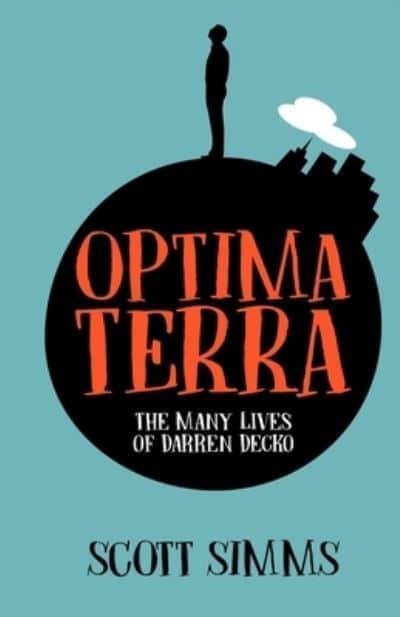
Optima Terra: The Many Lives of Darren Decko by Scott Simms

Optima Terra means Perfect World according to (Canadian?) author Scott Simms. The book is a light sci-fi tale that is both dystopian and utopian at the same time. Strange, right? Well, it is a strange story. I enjoyed this book and the adventures of Darren, the principal character, who finds himself in a myriad of bizarre situations.

What attracted me to this book was the cover - not because it was fancy, but because it was so minimalist in its design. The other element attracting my attention was the blurb - it just seemed like something I would enjoy.

The story opens with a seventeen-year-old Darren Decko in school. It spans his life through age twenty-six. During this time, Darren faces many challenges to him, both mentally and physically, while he strives to achieve the Gold status. The idea is to mount up points on his smart phone (or his "life card") through his performance on the jobs he is assigned. While in school, he meets the love of his life, a young woman named Rachel. In this highly regulated world, there are no guarantees people will see each other as they pass from one "Rotation" to another. A Rotation lasts 121 days. At the end of a rotation, all those except for skilled people - doctors, scientists, etc. - move from one place to another and perform different jobs or attend different schools as assigned by their life card.

Darren's life goal is to spend his life with Rachel, and he will do anything it takes to make that happen, including bringing down the Rotation System.

The story follows Darren for nine years of his life. He is a good person who is curious about the history of his world. He wants to understand the how and why of where he is. While he enjoys the benefits of the system, he is also dismayed by it because he does not know of his family. Family becomes very important to him as he gets hints about the world before the "New Era." When he meets Rachel, he wants to spend the rest of his life with her, but the system won't allow that. So, he decides the system needs to be changed. Darren is not the only one who wants change, there are many others who feel the same as he does. He decides the system need to be changed for everyone.

The key thing I enjoyed about the plot of this story was the elaborate and detailed world building by Simms. The plot unfolds through the backdrop of a world that provides everything people need to have a satisfying life within certain guidelines.

When a person finished school, they are sent into the workforce in the Rotation System. Everyone gets a new life every 121 days under the system. They are provided a place to live, complete with clothing, food, and an assigned job. Job assignments are sent to people on the first day of the new rotation. In one rotation, a person might be a garbage collector. In the next, they may find themselves a CEO of a major corporation. The training for these positions is provided while on the job, so it's a little stressful on the first days of an assignment.

Points are earned and awarded for adequate performance on the job, but points can also be taken away for poor performance or by committing an infraction of rules. Everyone is monitored by an army of flying robots - "bots" as they are referred to - and these bots may take points for rule infractions, failure to comply, or they may even hand out punishment.

Smart phones are vital to the citizens. They get information on their assignments on them as well as keep track of points on them. Phones are also a means of communication and work pretty much as they do for us today. One can store information, photos, locations of others on the devices, but they are wiped between rotations.

The world itself, Earth in the distant future, is a global community with no apparent government. There are no wars or conflicts, no environmental difficulties, and most people seem content with their situations. There are those who choose not to live within the system, and they are reduced to a low level of subsistence, barely squeaking out a living. Others not in the system have formed communities where they live an agrarian lifestyle that is difficult, but it is free.

A map of the planet is included at the front of the book to help one orient themselves as the story unfolds.

I'm not sure, but I think one of the themes the author wanted readers to think about is the dependance we have on technology in our world. Everything and everyone in Optima Terra is heavily reliant on tech. Everyone is monitored throughout their entire lives and the only thing that still seems private in life is one's own inner thoughts. As mentioned before, all the most basic necessities of life are provided for, but there is more to life than shelter and food. The society in this story has turned their lives over to the whatever power determines the rotations in the system. There are no long-term relationships on Optima Terra. Even how children are brought into existence is highly regulated. As I think about the world presented in this book, I know it is a place I would not want to live in. So, I think Simms is warning us to be careful to make sure technology remains a tool, and that we don't give up too much of our existence to it.

While the theme of machine control over humanity is usually framed as post-apocalyptic in most sci-fi, that is not the case in Optima Terra. This is a light sci-fi story meant to entertain more than frighten the reader and the writer did a good job incorporating humor in the text. Along with humor, there are many poignant moments, especially as Darren interacts with Rachel, and others important to him.

I recommend this story for those who want a relaxing read. It will be relaxing as long as one doesn't take it too seriously and think too deeply about it.

Scott Simms is a writer of urban fantasy and speculative fiction, preferring everyday situations with light sci-fi or fantasy elements introduced to an "everyman" or "everywoman."

I received an advance review copy of Terra Optima for free, and I am leaving this review voluntarily.

Well, there it is...

Qapla!

Thursday, December 27, 2018

Alien Blood by Stan Schatt - More Fast Paced Aliens Among Us Speculative Fiction

Alien Blood by Stan Schatt

Over the years, I have read numerous stories about aliens among us, watched numerous television shows, and listened to Coast to Coast AM hosted by Art Bell and, more recently, George Noory. I guess what I am trying to say is there is no shortage of speculation on alien life on Earth and conspiracies surrounding it. For me, it is all in good fun and is amusing to think about. Usually, I find movies and television shows on this subject somewhat hokey and quite unbelievable. If I am to be entertained by alien conspiracy stories, I am more likely to enjoy a good book that allows me to create my own visualizations as I read.

Not long ago, I received an email from author Stan Schatt in which he let me know that he had released a new book, Alien Blood. I have enjoyed Stan's work in the past and knew that I would most likely enjoy this latest release from one of my favorite indie authors.

The story opens with a scene in the White House with a new president being briefed on alien activity in the US. This is the first time the freshly elected leader of the free world has heard anything about such matters. He speculates on how it is no wonder that presidents leave office looking much older than they entered it. It seems that a treaty between two species of aliens, the Greys and the Draconians, and the US is about to expire and negotiations for a new treaty are not looking promising. Along with that, the new president is told many horrible things that took place during the past decades since the presidency of Harry Truman, and in order to save the country, not to mention the world, a new treaty with the aliens must be hammered out.

The story then switches over to former Navy SEAL Ben Swift. When his sister, Heather is kidnapped by some government thugs, he gathers a team of his former SEAL brothers to rescue her from what he learns is actually an alien group that wants to use her DNA for experimentation. Along with the other former seals. he is accompanied by a woman who is apparently a former foreign special ops agent named Sherry. Ben will stop at nothing to get his sister back. Along the way, he learns about several conspiracies leading him in a chase across the country, not to mention a trip to a secret base on Mars via a reverse engineered flying saucer!

As mentioned, Former Navy SEAL Ben Swift is retired and working for a tabloid paper one might would find in the grocery store near the checkout stands. He takes calls from the public and follows up on anything that might seem plausible, but usually finds most of the calls are from crackpots and lonely people who dream up scenarios from bits of information they obtain from others. But when Heather disappears, he goes into full SEAL mode and it doesn't matter if it is his own government he has sworn to protect and defend, he is going to get Heather back.

While Ben goes about the business of the rescue and its aftermath, the author craftily moves among numerous alien related conspiracy theories including a secret military base on Mars, a crashed alien ship on the moon complete with alien bodies recovered by secret Apollo moon missions, various types of aliens performing various types of experimentation with the blessing of the US government, and more. Schaat speculates (at least I am hoping it is only speculation) on numerous theories in his story that moves at a very fast pace.

This is the second book set in this universe Stan has created in which he explores conspiracies and lore surrounding alien life. Most assuredly, it is some fun speculative science fiction that, at the same time could give one a few things to think about. The pacing of the story is extremely fast, never letting up for a second. I was engaged from the opening line to the very end of the book which I read very quickly because I just had to see what happened on the next page.

The language is plain talk with very little jargon to wade through making it easy to understand and follow. I especially enjoyed how the author went about showing the story instead of simply telling it. His descriptions of people, places, and things got to the point rapidly, but in such a way that it helped the flow of the book.

While I in no way think that the Earth has been visited by aliens (and I do not intend to present my reasons here), The story is written well enough to make it seem quite plausible. I think that is one of the main reasons I enjoyed this story so much. With any certainty we humans have, there is always a shadow of a doubt that perhaps the other side of the story may have a ring of truth to it. Stan's characters could be people that we know, the places may exist as he describes them, and the situations may also be things that could happen in the real world. This is where Stan Schaat shows himself to be a master at inserting his ideas into that door where the shadow of a doubt exists and little by little, pushing the gap in the door just a little wider.

Alien Blood is the second installment in a set of two stories in which Stan presents his speculations. The first, Alien Love, has many parallel themes and elements, but is not part of what I would consider a series. Both of these stories are stand alone with a definite ending, but they both make me want to read more. I have to say that I was very surprised by the plot twist at the end of Alien Blood. I certainly didn't see it coming, but found it to be another interesting and satisfying aspect to these books.

As always, with Stan's stories, there are many references to popular culture that many of us commonly know, but especially numerous references to Star Trek, which only serves to add to the fun.

I contacted Stan via the internet to ask a question and he intimated to me to watch for another Alien book that he recently finished. Yes indeed, I am looking forward to that!

I recommend Alien Blood as a fun story that will take a reader on a fast paced ride through a world filled with intrigue, conspiracy, and aliens who all seem to have an agenda for the people of the planet Earth, but at this point is only really known to them.

From Stan's website, here is how he describes himself...

"Futurist, technologist, novelist, and a person curious about many things. The roll call of jobs I’ve held over the years includes but is not limited to autopsy assistant, police department administrator, salesman, sales manager, literature professor, telecommunications professor, and technology analyst, and research director. I’m a full-time writer now and live in Carlsbad, California with my wife, Jane. My plate’s pretty full right now with writing projects. I’m writing primarily mysteries at the moment when it comes to fiction and non-fiction books on careers and retirement. I have always loved technology and politics almost as much as writing."

You can find a more complete list of both his fiction and non-fiction work on his website, and there is a short list of his works at Amazon.com.

Well, there it is...


Qapla!