Notice...

The purpose of this blog is to have a little fun. It is NOT to start arguments. I don't profess to be an expert on Sci-fi, nor do I aspire to become an expert. You are welcome to comment on any and all content you find here. If my opinion differs from yours, as far as I am concerned, it's all okay. I will never say that you are wrong because you disagree with me, and I expect the same from those that comment here. Also, my audience on the blog will include some young people. Please govern your language when posting comments.

Posts will hopefully be regular based on the movies I see, the television shows I watch, and the books I read as well as what ever strikes me as noteworthy.


***SPOILER ALERT***
Spoilers will appear here and are welcome.

Autograph Collecting

Showing posts with label Futureistic Sci-Fi. Show all posts

Sunday, March 24, 2024

Echo: A Space Opera Duology (Book 2) by Michael Listen - Fun And Thoughtful Space Opera

Echo: A Space Opera Duology (Book 2) by Michael Listen

The second installment of the Echo space opera duology is a satisfying end to a story that I found spellbinding and just plain fun to read.

In the first book, the reader gets to know Kai Randall, a bit of a pirate with a good heart and a solid sense of justice. He becomes an unlikely hero when he rescues Shreya Nova, a scientist and military officer whom he rescues despite the beating she gives him during their first meeting. Added to those two are Perri Hasana, a young woman who has ambitions of being a pilot but is an apprentice to Kai (click here to see my review of the previous book). Together, Kai and Perri gains Shreya's trust sufficiently enough for them to help find her missing husband who was kidnapped during the test flight of a new propulsion system.

Echo 1 was loaded with gut busting humor in an otherwise tragic story of loss and brutality. This volume takes a bit of a darker turn and is terrifying when we finally meet the alien race responsible for the kidnapping and all of Shreya's heartaches. Add to that the continuation of one of the most despicable characters I have ever met in a story, and you get an amazing story to tug at your emotions and might even take you to the breaking point.

Ignoring all available evidence to the contrary, Shreya refuses to accept that her husband is dead and will continue to search for him until she has evidence otherwise, and she is willing to go to any lengths to learn the truth. Kai wakes after healing from injuries he sustained in the previous novel and realizes the feelings he has for his young apprentice.

With a bounty on his head, Kai and his crew head off to an uncharted region of the galaxy and encounter a race of beings so powerful, it is doubtful they will survive.

The action and adventure ramps up to a captivating and satisfying conclusion that will absolutely break the reader's heart along the way. Be sure to have a box of tissues handy as you read this one!

My favorite plot point for this second book revolves around one of the most powerfully compelling characters in any story I have ever read. That would be in the person of Parri Hasana. She is quick-witted, highly intelligent, and able to adapt to unfamiliar situations. I place Parri at the top of my list of the greatest of female characters along with Ellen Ripley.

My takeaway from both parts of Michael's duology is the role of persistence in them. I once saw a quote: "Success is not the absence of failure; it's the persistence through failure." The quote is attributed to Aisha Tyler. First, there is Kai. He could have easily just walked away from Shreya at any time, yet something inside him spurs him on and emphasizes his humane side. Shreya will not give up on her husband, no matter what. And Parri continues to follow her heart. She will not give up on winning Kai's heart.

Even the villains show monumental persistence. The evil commander who tortured Shreya in Echo 1 is back, and he is not giving up seeking his revenge. And there are the aliens who have persistence at their very nature.

In short, the Echo Space Opera Duology, is among the best Sci-Fi I have ever read. It is an amazing, well-told saga that runs a full gamut of emotional content. It will entertain and inspire readers, and I give it my highest recommendations. Don't miss this one. The story unfolds at a good pace and is hard to set aside once you start reading.

Rating:⭐⭐⭐⭐⭐

Michael Listen lives in Oklahoma with his wife and two children. After his time in the Navy, he moved into the Information Technology profession. However, he has always had a passion for art and creativity. He enjoys crafting stories for role-playing sessions with friends or writing short stories for his wife. His first full-length published book was a two-part science fiction space opera titled Echo.

Well, there it is...

Qapla!

Sunday, December 18, 2022

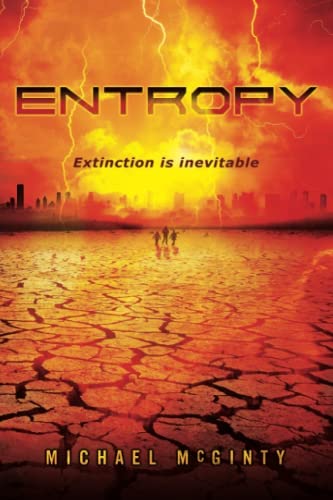
Entropy By Michael McGinty - A Hard Sci-Fi Look At A Grim Future For Humanity

Entropy: A Novel by Michael McGinty

I received a copy of this book for free and am leaving this review voluntarily.

The story in Mike McGinty's debut novel, Entropy, is an attention-grabbing tale of a future when things have gone from comfortable to terrible for principal character Bill Bartles, as well as the world he lives in. It is a fast-paced story of a man who is charged with looking at past events, stripping away all the static, and uploading what he filteres to a database contained in a space no bigger than a shoebox.

Entropy is a hard sci-fi, dystopian look at a grim future for humanity.

When I began reading Entropy, I found it commanding my attention. I was mesmerized by the story in its pages and whenever I had time to pick it up, I was drawn into a nightmarish world where chaos rules, and it's everyone for themselves.

I enjoyed Entropy. It ran me through an entire gamut of emotions, from being horrified, through sadness, and even some triumphant moments. It is an intense look into the future where there might be danger lurking around every corner. I had to pay attention because there were a few things I knew little about - at the same time, everything was adequately explained.

Bill Bartels lives in a city where life is strictly regulated. As long as one follows the rules, everything seems to work well, but going against established procedures have consequences. His life is quite comfortable - he lives in a nice apartment, has a girlfriend, and nearly everything he needs to live. He works near the bottom of a corporate ladder that goes very high. His job is to gather all human knowledge, sift it to be sure there is no spin left to taint the information, and finally store it on a device called the Infinity Drive. Bill does his job so well, he expects a promotion soon, but something goes wrong.

During a session taking a deep dive into the archives of the Infinity Drive's controller, he finds something disturbing. Outside the city is death and devastation, the result of numerous man-made disasters. In effect, Bill discovers a state of social entropy existing outside the city, and he is compelled to investigate. What compels him is that he is caught discovering forbidden information and the corporations do not want it to become common knowledge. He escapes the city and enters a world the likes of which he had no idea existed.

Along his journey, he discovers many disturbing facts and learns that humanity is doomed to end in the not-too-distant future.

For much of the tale, Bill is accompanied by an antisocial curmudgeon, simply known as The Thinker, who helps Bill with his decision if saving the dregs of humanity is worth the loss of the Infinity Drive.

The Thinker takes Bill on a tour of the ruined world and presents him with some disturbing looks into the realities of Social Entropy.

My favorite point of plot is the author’s illustration of the extremes between strict social control, and the lack thereof. It shows what can happen in two different worlds on the same planet when things are out of balance. It made me think of a lot of the things I witnessed during the height of the recent COVID Pandemic. How panicked people were hoarding supplies. How people began making their own rules and ignoring established laws. How people were behaving irrationally in general. Had things not calmed down, what might our world look today? I shudder to imagine it. We got a glimpse looking into an abyss, but Entropy takes it the rest of the way. It is not a world I would want to live in.

Another favorite point of plot was how the mood of the story changed in the blink of an eye. As the story opened, I felt as though I were reading a comedic story. There were things that struck me as being funny, but that didn't last long as the life of the principal character became unhinged as he became more aware of the realities of the world he lived in.

The overarching theme of Entropy is Social Entropy, as outlined by the second law of thermodynamics. My takeaway is an understanding of the concept of Social Entropy. When the constructs of living in communities break down, when there are no longer laws, in the absence of institutions that maintain order, society descends into chaos. It is a point at which irrationality rules and survival is the rule of the day. The strong survive at the expense of the weak. One example cited in my reading was what happens during war.

Entropy will make one think. It has a very familiar flavor in the light of headlines presented in the last few years. It takes the themes we have witnessed in reality and projects them into a future where it wasn't pulled back from the brink of tipping into disaster. We are still healing from the chaos witnessed during the pandemic, but this story gives us a look into what might be if some disaster, or combination of disasters, is left to follow its course. I see Entropy as a warning to societies telling us to take care of each other or we may face our own extinction.

I recommend this book to readers who like hard sci-fi and who enjoy post-apocalyptic and dystopian themed books. It is well thought out and disturbing. It caused me to have a few nightmares. While that may seem like a bad thing, perhaps it is just what we need to keep humanity moving in a positive direction.

Rating: ⭐⭐⭐⭐⭐

Mike was born and raised in Kalgoorlie, in the goldfields of Western Australia, before moving to Perth to complete a degree in Electronic Engineering. With a good science fiction book in hand and a lifelong passion for innovation, Mike has always imagined a future where technologies that are improbable today might be possible tomorrow. When not writing, Mike runs a software development company at cyinnovations.com, loves 1970s heavy rock music, and cheers on his beloved West Coast Eagles AFL team. And he often goes fishing in the Australian never-never. Together with his wife, Mike lives in an empty nest with their black Labrador, Louie.

Wednesday, June 8, 2022

Bouncing Off the Moon: The Far Side of The Sky Book 2 by David Gerrold - More Sci-Fi Goodness From A Master

Bouncing Off the Moon: The Far Side of The Sky Book 2 by David Gerrold

I finished reading the first book in this series, Jumping Off the Planet, a few weeks ago and gave it a five-star review. Bouncing Off the Moon continues right where the first installment ends. This is a tale of an estranged family with parents who are more childish than their children. It is very a very sad state of affairs when parents use their children as weapons against each other; everyone suffers, especially the children.

The story, so far, is told from Charles's point of view. He is the middle child of three brothers who are all different in their interests and behaviors, but they have one thing in common; they depend on each other for support and survival.

Bouncing Off the Moon is a brilliantly written story told in the classic sci-fi style. It is set wholly on Earth's Moon and the descriptions of the backdrop colorfully illustrate the colorless landscape of the colonized satellite. I couldn't help but think about Buzz Aldrin's observation when he encountered the body in 1969. He called it "magnificent desolation" and David brings those words to life in this book.

I was most impressed by the pains the author took to get the science right. However, what really drives the story are the characters.

This second book isn't your typical bridge between the beginning and the end of a trilogy, but it is a complete story unto itself. I found it exciting, scary, sad, and humorous; running a full gamut of emotions.

Charles, also known as Chigger, his two brothers, Bobby the younger, Douglas, the older, have just won their emancipation from their parents and are striking out to seek their fortune among the stars. Economic and political conditions on Earth have deteriorated to where its society seems doomed to collapse. The brothers are accompanied by Mickey, Douglas' newly found love interest.

Realizing they are being pursued for a toy they have in their possession; they learn they have to take an alternate way to avoid being captured. Bobby's toy contains something precious to many people. The boys are joined by Alexei, a friend of Mickey's and a resident of the Moon, who helps them escape from the tether in a cargo pod before they can be captured.

As a resident of the Earth's natural satellite, Alexei knows how to get around and he takes the boys on a fantastic adventure crossing the Lunar surface to seek safety. After arriving at a safe place, all is not what it seems, and the boys must watch their backs because there is uncertainty at every turn.

As for the characters in this second part of the tale, there is significant growth in the brothers. In the first book, they really had little in common with one another other than the schism brought about by their parents. Since they have been away from that influence, they have become closer and depend on one another for strength and support.

The story is told from Chigger's point of view, and we get to follow his feelings through the numerous new, strange, and dangerous situations the boys face. David wrote this story so one can feel what the boys feel, especially Chigger. As a young teenager, he is already emotionally compromised just because of the age. I have to say, though, that he handles much of what he faces well for his age.

My best advice for a reader is to keep an eye on all the characters. Some are not what they seem.

My favorite point of plot for Bouncing Off the Moon is all the swerves, twists, and turns this story takes. Just when one thinks this story is going to be predictable, it takes a turn and moves in another direction. I thought for sure I had a couple of characters figured out, only to find I was completely wrong about them. This alone makes this tale a fun one to read, as David takes the reader on an emotional and literal roller coaster ride.

Another point I appreciated were the descriptions of the surroundings and how the characters move through them while on the moon, not to mention how they get to the moon. The science is well researched, and it adds so much to the authenticity of the story. Everything the author shows the reader in this story is completely plausible. Indeed, it is all made up, but everything is so practical, it wouldn't be difficult to say that David is projecting today’s technologies into the not-too-distant future.

One takeaway from this story is how one must know their surroundings with great diligence. This is true especially with the people once interacts with. With the brothers, they had little choice in who to ally themselves with and it could have cost them their lives had they not been suspicious of nearly everyone they encountered.

But even more, during a scene near the end of the book, two characters get into a discussion of a legal and philosophical nature. The question posed is, "when it is appropriate to break the law?" Many would argue that illegal activity brings about change, but then at what cost does that change take place? Then there is the idea presented by American author, Henry David Thoreau, in an essay commonly known as On the Duty of Civil Disobedience. In nearly every book I've read by David Gerrold, there is something to give me pause and think. As for me, I think this small section is worth the price of the entire book. The conclusion to the argument is, "... it is never appropriate to break the law. It is, however, appropriate to challenge it responsibly." (p. 268, Kindle edition)

Not only is this my favorite part of the story, it is thick with substance and well worth the time, especially in the current political climate.

I recommend Bouncing Off the Moon along with the volume that comes before, Jumping Off the Planet, as something worth the time to read, not only because of the immense entertainment value of the saga but also to have one's mind stimulated with issues relevant to life today. David Gerrold's skill as a writer is shown in this story because the deep issues are not presented in a preachy way, but they are presented as important story points moving the story forward.

Highest recommendations for this book as well as the series (so far) as a whole.

Rating: ⭐⭐⭐⭐⭐

David Gerrold lives in California with his son, daughter-in-law, and his toddler grandson. He is the winner of numerous awards for his writing. You can follow him on Facebook or through his Patreon page. He is a self-described curmudgeon, and you are strongly advised not to tread on his lawn.

Well, there it is...

Qapla!

Sunday, May 1, 2022

Alien Isolation (Audiobook) by Keith R.A. Decandido - A Complete Package Of Great Story, Characters, And Narration!

Alien Isolation (Audiobook) by Keith R.A. Decandido

In preparation for a day trip to Kansas City, Missouri, to attend Planet Comicon, I downloaded Alien: Isolation to accompany me on the drive. I found this a great choice for an audiobook for both content and narration. Keith is one of my favorite authors, mostly for his work in the Star Trek sandbox, and particularly for his portrayal of Klingons in his work. Knowing the quality of his work in the Trek universe, I was not surprised to find the same level of quality in this story from the Alien franchise. Overall, I found Alien: Isolation a refreshing diversion from the monotony of cross-country driving.

This story is based on the video game of the same title as the book. (I've never played the video game, nor did I know anything about it before I looked it up.) This is the tale of Amanda Ripley, daughter of Warrant Officer Ellen Ripley of the ill-fated cargo ship, Nostromo. Apparently, Ripley revealed she had a daughter back on Earth during the Aliens film in a scene that was cut from the original movie. This story fleshes out Amanda's plight using flashback scenes to give us some insight into the principal character, and the main story of Amanda's struggle to learn Ellen's fate and her struggle to survive encounters with the xenomorphs.

Keith's story is fast-paced and was well balanced between the flashbacks and the principal story. The descriptions of the settings were easy to visualize, and the characters were excellently developed and read as believable living people. The narration by Sarah Mollo-Christensen was also outstanding and further brought the action and characters to life.

Ellen Ripley departed on the Nostromo after promising her young daughter, Amanda, she would return in time for her eleventh birthday. As Amanda awaited her mother's return, she only finds deep disappointment when she is informed Ellen will not return because the Nostromo was mysteriously destroyed en route returning to Earth, and that her mother's fate is not known.

Amanda, who is being raised by her alcoholic stepfather, has a rough life. Her ambition is to attend school, learn all she can, and learn of her mother's fate. After following several false leads, she finally receives word that the Nostromo's flight recorder has been recovered and is on a deep-space station.

When arriving at the station, her ship and crew find themselves in a desperate fight for survival against the very creatures that ravaged the Nostromo's crew. Amanda must use all her knowledge and wits to escape death and find out if she will ever see her mother again.

Amanda Ripley is not Ellen Ripley, at least not right away. She is smart and learns fast. Her intention was to become a certified engineer. While she did become an engineer of sorts, the certification eluded her for many reasons. Chief among those was her stepfather who, while capable, had a lot of problems with alcohol, and by extension, holding a job. So instead of being able to pursue her ambition, she had to work to support herself and her often unemployed stepdad to survive and avoid being taken into the system.

Those of us who have followed Ellen's exploits through the Alien franchise admire her as a tough, yet compassionate, and heroic character. Amanda has these same traits as she goes about the business of seeking hope her mother somehow survived the Nostromo disaster. Aboard the space station, there are dangers everywhere. Yes, there is the monster, but at the same time there are numerous system failures she must keep repairing, and, she has to deal with the personnel issues as the crew also breaks down and enters an ‘everyone-for-themselves’ survival mode. In the end, Amanda is every bit the hero as her mother.

As always, there seems to be another enemy to fight who never shows its face. Readers/listeners probably will not be surprised at the reveal who the hidden enemy is.

My favorite point of plot for Isolation is how well Amanda's character is fleshed out to become someone a reader can care about. Without this aspect in the story, this tale wouldn't have been extraordinary. I felt so bad for this brilliant little girl and absolutely wanted her to be successful in achieving her goals. It was sad that at every turn; she was thwarted and forced to serve in a menial role so far below her intellect. It is my hope that Keith may tell more of this tale outside of the novelization of the video game. He just knows how to spin a great yarn, and I know his treatment would be a satisfying story. 

The obvious main theme of Isolation is a look at someone who survives against insurmountable odds. But my takeaway from this story goes a little deeper than Amanda versus the monster. It is more how Keith endows her with a strength of character that allows her to survive.

There is no quit in Amanda. She is going to persevere no matter what she is told or what obstacles are put in her way. It would have been so easy for her to just accept being told Ellen was dead and move on from there. She might have, but it was that tiny seed of doubt that drove her on to do whatever she had to do to uncover the truth. I admire her for this, and it is what kept me listening as I made my way home from Kansas City.

Alien: Isolation is a great audiobook and I highly recommend it to those who are fans of the franchise and are looking for more story. It moves at a great pace. There just isn't a dull moment or what one might think of as fluff. Everything is relevant to the story. The characters, along with Amanda, are great and help the listener/reader understand the principal character better. Even though the story is complete in itself, it still left me wanting more and it is my hope there will be more in the near future, especially if Keith DeCandido is tapped to be the author.

Novel Rating: ⭐⭐⭐⭐⭐

Narration Rating: ⭐⭐⭐⭐⭐

Keith R.A. DeCandido was born and raised in New York City to a family of librarians, which pretty much explains everything. He has written more than 50 novels, as well as short stories, nonfiction, eBooks, comic books, and blog entries, many of them in various media universes, among them Star Trek, Alien, Supernatural, World of Warcraft, StarCraft, Marvel Comics, Cars, Farscape, Buffy the Vampire Slayer, Stargate, Serenity, Resident Evil, Kung Fu Panda, Doctor Who, Sleepy Hollow, Leverage, Orphan Black, and more. Among his many works of original fiction are the fantasy police procedural series of novels and short stories that started with Dragon Precinct, as well as a series of urban fantasy short stories set in Key West, Florida, many of which are in Ragnarok & Roll: Tales of Cassie Zukav, Weirdness Magnet, fiction about cops in a city filled with super heroes, and an urban fantasy series about a nice Jewish boy from the Bronx who hunts monsters, starting with the novel A Furnace Sealed. Keith is also an editor (having supervised several book lines and put together dozens of anthologies), musician (percussionist for the Don't Quit Your Day Job Players, the Boogie Knights, and others), pop culture commentator (he writes for both Tor.com and his own Patreon at patreon.com/krad) and a third-degree black belt in Kenshikai karate (he both trains and teaches). He still lives in New York City with various humans and animals.

Sarah Mollo-Christensen (Narrator): Sarah grew up riding horses outside Boston, and went to Dartmouth College, where she graduated magna cum laude with a BA in History. 

After a few years working in other industries, such as documentary production, book publishing, and law, she threw caution and financial responsibility to the winds, and decided to apprentice herself to a dog trainer and attend the Atlantic Acting School's two-year Conservatory. 

In the years since, Sarah has acted in New York and at wonderful regional theaters, including The Shakespeare Theatre Company in Washington, D.C., where she spent a year in residence as an acting fellow.

When she's not in a theater or an audio booth, Sarah can be found resolving the behavior issues of New York City's dogs (and their owners).

Entropy by Dana Hayward - Solid Characters And A Great Tale Of Scientific And Political Intrigue

Entropy by Dana Hayward

I received an advance review copy of Entropy for free and am leaving this review voluntarily.

It is always a great day when I open my email and find a note from an author asking if I would be interested in reading their new book. When author Dana Hayward, who appreciated my review of another person's work, offered to send an advance copy of his new work, Entropy, along with a synopsis, I was more than happy to oblige.

There is nothing about this book I didn't enjoy. It is a fast-moving piece set in a not-too-distant future where there has been a lot of scientific advancement. The characters are well developed and display growth as the story advances. Most are easy to relate to and might be people I would want to know. But, while the story is fast-paced, and I enjoyed reading it, it is also quite disturbing, as I am sure it is meant to be.

While set in the future, many of the ideas in Entropy could be headlines from today. There are many plot points that felt all too real as I read and make me realize how easily fiction can become reality. In that way, this was a frightening read because the author takes us to possible new realities even beyond what are in current headlines.

The name of the game in Entropy is survival in a seemingly unsurvivable situation. There won't be many winners in this game, and the losers will just be dead.

For some mysterious reason, the Earth has lost its ability to sustain itself as a viable system. Everything is breaking down as the planet seems to approach a dangerous equilibrium of nothingness. Life is disappearing at an alarming rate and the human population is experiencing shortages of everything, including breathable air, potable water, and food. Chaos is rapidly becoming the order of the day as a few people try to address the problem, or become predators, taking from those who have without regard for others.

Governments cannot help and determine it is time to look to alternate living arrangements such as moving out into the solar system, leaving the Earth behind.

U.S. President Myung Kim determines the only course is to give people hope by first establishing a permanent colony on the moon to be used as a jumping off point for permanent relocation to Mars. Much of the infrastructure for this is in place, but how will the people be fed?

John McCabe is charged with coming up with a solution to the food problem. He is to create a cultivar, a type of edible plant that will grow quickly under the harshest conditions.

As conditions continue to deteriorate, the country falls further into chaos because of famine, plague, and civil uprising. Also looming on the horizon is an inevitable confrontation with the Chinese government.

There is hope when a new republic form on the moon and decides to strike out for their inevitable destination to begin life anew on Mars.

There are several characters in Entropy one may consider being principal to the story, but I have to admit, President Myung Kim is my favorite.

Kim, a solid female character who is not affiliated with any political party, works to surround herself with the best possible people to address all the problems. She prioritizes well and addresses each problem that comes up as best she can. Even with everything happening, she remains calm and relies on her expert advisers to help with decisions, but she still has the vision to see what the future will bring. By recruiting the best people to handle the problems, she can stave off starvation and jumpstart a solution to solving problems with science as her central tool.

She is a truly refreshing character who faces a tragic end, but not before she can make things right amidst seeming impossible odds.

My favorite point of plot in Entropy is how science emerges as the best way to come up with answers to problems. In this time where there seems to be an attitude that science is some kind of sinister plot to control people, it is good to see there is hope that, one day, we may realize it is through science we get the answers to the really hard questions.

Growing up during the 60s and 70s, I was part of the movement to educate the public on the benefits of science. To my deep dismay, it is alarming to see the current trends of the 21st century denial of empirical evidence right in front of our eyes. It is encouraging to read a story where science is valued by political leaders.

My takeaway from Entropy is hope for the future. While recent historical events, such as the COVID pandemic, created, at least in me, a deep sense of hopelessness for the future, Hayward shows that no matter how bad things get, there is still the possibility of making a better world.

Beyond the message of this tale, Entropy is just a great read, and I recommend it for that alone. It is truly a novel that sustains suspense, and I hated putting it down when I had to and was aching to get back to it when I had the time. According to the author, this is just the opening to a saga, and if it is any indication of the quality, I am also eager to read the next book in the series.

The characters are well written, each with their own clear voice, the descriptions of the settings are vividly colorful, and the situations will have the reader experiencing a plethora of emotions. This is a novel of epic proportions and has the making of an amazing series of books I want to read. I give Entropy my highest recommendation as a Sci-Fi apocalyptic thriller that moves along like a chess match between characters and their environment.

Rating: ⭐⭐⭐⭐⭐

DANA HAYWARD aka Mark Muse

MARK MUSE has researched, written, edited and published original works in the area of clinical psychology, psychopharmacology, chronic pain, health psychology and psychosomatic medicine.

(https://www.amazon.com/Mark-Muse/e/B007P2ZKSS)

DANA HAYWARD is Mark’s alter ego, who writes fiction, science fiction; as in “ENTROPY”.

Please follow my blog at: https://danahayward@blogspot.com

Well, there it is...

Qapla!

Saturday, March 12, 2022

Renegade: The Companion Chronicles Book 5 By Joshua Todd James - Mayhem In A Mining Town Where No One Is To Be Trusted

Renegade: The Companion Chronicles Book 5 by Joshua Todd James

I received a review copy of this book for free and am leaving this review voluntarily.

Renegade is the fifth book in the Companion Chronicles series by Joshua Todd James. Picking up where Man in a Box left off, we continue following the adventures of artificially intelligent android Jacob Kind. Jacob, synthetic person, witnessed the murder of his owner, mentor, and as Jacob refers to her, his mother, Sylvia. He knows who the murderer is and is chasing him across the country to see that justice is done. He is being sought by the police for being a cop-killer, and by the company who built him because of the changes he has undergone through his ordeal.

Overall, I have enjoyed this series of books with great enthusiasm, including this volume. At the same time, I am deeply disturbed by the dark turn taken by the principal character. It is no surprise to that this has happened because the author is plumbing the depths of the darkest part of humanity. Through reading this work, I find myself happy to be who I am to have never experienced the side of society Jacob has been forced to witness as he pursues his quarry. 

As with the rest of the tales in the Companion Chronicles series, this is a story that will hopefully make readers think and look inside themselves. By exposing the darkest parts of ourselves, perhaps Joshua will help us want to be better humans. 

Companion Jacob Kind is on a quest for justice for the murder of Sylvia, his Primary. He has been through a lot and has learned to kill when necessary. After escaping a brutal fight club situation, he comes to a town where he is mistaken for someone who has been hired by a mining company to kill a member of the community that has proven to be an inconvenience.

Jacob, finding himself in need of money, takes the offered bounty and heads off to investigate the situation. He meets and falls in love with Raven, a member of a group of environmentalists who also engage in acts of terrorism and give him a counteroffer to take out the head of the mining company.

Taking their money, he plays a dangerous game of chess as he manipulates one side against the other while determined to keep Raven out of the line of fire.

Before it is all finished, the real hired assassin and Jacob's nemesis, Munson Tolliver, arrives on the scene where to two vow that one day in the near future, they will have their final showdown.

The principal character, Jacob Kind has changed. He is no longer the innocent and naïve artificial person he once was. He has been through the ringer and has learned to be a brutal killing machine. He still maintains his sense of justice, but his capacity for violence and appalling human behavior has ramped up to a terrifying point. Jacob cannot be blamed for this eventuality owing to all the inhumanity he has witnessed during his short life.

It saddens me to see the direction Jacob's growth has taken. While he still seeks justice for Sylvia's murder, he has also decided to take it into his own hands, resolving to kill Tolliver himself, rather than bring him to the system. But who can blame him? He has had little to no help from anyone, nor has he seen any example of the system working. As a matter of fact, the system doesn't allow any room because there are no laws protecting his kind.

He is performing as he has learned, and his education has not been in any way positive.

My favorite point of plot in Renegade is a glimmer of hope for Jacob in the form of Raven. She is the supposed leader of a group of terrorists who claim to environmentalists, but she is also the only one of her group who is genuinely what she appears to be. The rest are using her as a figurehead to keep the heat away from themselves.

We see a little of Jacob's innocence surface when he strikes up a short relationship with Raven, and he sees it as a possible long-term situation. But Raven is a self-proclaimed "free-spirit" and Jacob hasn't really had an experience with such a person.

My takeaway from Renegade is a little different than it has been for the previous books. In this tale, it is a look at how Jacob has assimilated the worst of humanity and learned to use it with deadly efficiency. He has become a little greedy, a killer without remorse, and he has learned to manipulate people.

While I find it a sad situation for a character that would otherwise have a great capacity to do good, he has been forced into the position he is in to survive long enough to achieve his goal, the elimination of Munson Tolliver at any cost.

As with the rest of the Companion Chronicles, I give Renegade my highest recommendation as stories that will make the reader think about their own implicit biases and what the result of unleashing those biases might be.

Rating: ⭐⭐⭐⭐⭐

Joshua Todd James is a novelist, screenwriter, and playwright based in New York City. He wrote the feature film Pound of Flesh, starring Jean-Claude Van Damme, among others. He is a member of WAGE and is represented by Snowpeck Management and Gersh.

His books include The Companion Chronicles which detail the adventures of synthetic person Jacob Kind in the books titled Some Animals, Minority of One, Freedom Run, Man in a Box, Renegade, and Domo Arigato, Mr. Robato.

You may join Jacob's chase for justice on the author's website: Joshua Todd James.

Well, there it is...

Qapla!

Terms Of Service: Subject To Change Without Notice by Craig W. Stanfill - A Look Into The Future, Or Perhaps The Present

Terms of Service: Subject To Change Without Notice by Craig W. Stanfill

I received a review copy for free and am leaving this review voluntarily.

I wasn't sure what to expect when I downloaded this book; I am happy to say I immensely enjoyed it.

Terms of Service is set in a dystopian world about 250 years in the future. It is full of hard sci-fi concepts and many ideas from today projected into the future. It reads like futuristic sci-fi, but also feels very familiar in the now. Imagine a world in which there is absolutely no privacy whatsoever. Everything you do and say is constantly monitored and regulated. This is the future that author Craig Stanfill envisions, but he also causes one to stop and think about personal privacy.

In this world, there are rules that are strictly monitored and enforced with few privileges for those who are not at the top of society. Break the rules and punishment is swift and can also be severe depending on the infraction. Smaller infractions are usually more irritating or inconvenient, and major problems could result in being assigned to hard labor outside of main society.

At the beginning of the story, it is actually more humorous as we get to know the principal character simply called Kim. She goes about her life with frustrations, causing her to endure minor inconveniences. However, as the story progresses, the saga becomes darker and more frightening.

Kim lives a mundane, work-a-day kind of life in the big city. One could consider her a middle-class citizen. She has a job working for an AI company, a small spartan apartment that is fully automated. As long as she is employed, she want's for nothing except a little adventure now and then.

However, Kim is not a happy person. She goes home after work to have her dinner, which is determined by her artificially intelligent refrigerator, and view what is on the vids on her visor entertainment system. After that, she drinks herself into a stupor and sleeps until it is time to start all over the next day.

After a rather large misadventure, the company determines she is worth more time and is "promoted." Her living arrangements improve, but her new position causes her some consternation, and she learns what is expected of her.

I found the principal character, Kim, to be someone I would like to know. She has a few radical ideas about things that go against the norms of the society she lives in. Afforded few luxuries, she has a life that is unremarkable for the most part, mostly living within the rules of the company. But now and then, she gets sidetracked by friends and develops a sense of justice that could lead to her downfall. I like her. She is a nonconformist and thinks for herself.

As I mentioned, the first part of the story was amusing. I laughed at several points before the story took a more sinister tone. The things I found most fascinating was how Kim's refrigerator closely regulated much of her life. If she wanted steak for dinner, the fridge would deliver tofu. Her struggle with the appliance was never ending. She would commit some small infraction and the machine would dispense items she didn't want. Sometimes, her apartment would monitor her reaction to something it had served her, and if she seemed to like it, she would get more of it, often more than she really wanted.

Even her shower would mete out punishment for small infractions. Break some small rule and it was a cold shower the next morning.

If Terms were intended to be a comedy, those examples would be funny, but what the plot point actually does is use a light tone to set up what comes later. As the plot is rendered, those pesky appliances, as well as other AI controlled items, contribute to a terrifying situation later in the tale.

My takeaway from Terms is the idea of privacy, now and in the future. There is none. I have said for a long time that privacy is a myth. And the question is, who has taken away our privacy? As far as I am concerned, we have done it to ourselves.

Do you have a cellular phone? Do you interact on social media? Do you shop online? If the answer to those is yes, then I contend one has no privacy. I do all three and see evidence of it all the time. If I buy a book on Amazon, I immediately get ads by email and on social media, suggesting a plethora of suggestions for other books I might like. If I mention where I am having dinner, I get all kinds of suggestions for where to have dinner in the future, complete with coupons! It never ends.

In terms, the concept of no privacy is taken to the extreme, where every movement Kim makes is monitored and recorded for later use against her.

The really sad thing is, even though the author has set this story in the distant future, he also explains how much of what he writes is reality, and it is happening now.

Technology is a wonderful thing. It gives us information at our fingertips. It guides on our journey to get from one place to another. It puts us in immediate touch with our friends and family. But at what cost? Think about it.

Terms of Service is a highly entertaining, well-written story that will make the reader think about the present and the future differently, as the author intended. I honestly could not put this book down for long and had to get back to it when I had to set it aside. I’m recommending it for its entertainment value and the warning it contains. I would not want to live in the future as described in these pages, but it would also seem that the future is now. If you found Orwell's 1984 disturbing, be warned, this is like that tome on steroids!

Rating: ⭐⭐⭐⭐⭐

Craig W. Stanfill obtained his PhD in artificial intelligence in 1983, and has spent his career doing ground-breaking research in AI and enterprise computing. He has written numerous scientific papers, co-founded a software company and been awarded more than 80 patents. He continues to work in technology as he begins a second career writing speculative dystopian fiction. Dr. Stanfill lives an active lifestyle, and is an avid bicyclist, skier, sailor, and musician. With his wife, Sharon (herself a software engineer), he has roamed the world, always seeking out new places and cultures to explore. Together they have one son, who has followed in his parent's footsteps as a software professional and now works for a high-profile technology company.

Well, there it is...

Qapla!

Friday, February 18, 2022

All Systems Red: Murderbot Diaries Vol. 1 by Martha Wells - This One Just Didn't Work For Me

All Systems Red: The Murderbot Diaries Volume 1 by Martha Wells

This book appeared in an ad on Facebook and the cover caught my attention. Then I read the blurb and was further intrigued, so I borrowed it from Kindle Unlimited.

All Systems Red is a sci-fi novella by Martha Wells. It is about the musings of a manufactured cybernetic organism that refers to itself as a Murderbot because of an incident it was involved in at a time before this story takes place. The being is actually a mobile security system charged with making sure a small group of scientists on a distant planet are safe.

I'll say at the outset that I am a little cold on this story. I liked the idea and was hoping it would be better than it is. Unfortunately, there didn't really seem to be a point to the story, and it left me with a lot of questions. There are five more stories in the series and would be willing to read the rest of them, but not at the price the entire series costs. Each book is about 150 pages and the sell for $10. Sorry, but I don't think I am going to pay that much to read the books not on Unlimited.

I will also add that, as far as reviews are concerned, I find myself in the minority of readers who absolutely love this book and the rest of the series. Amazon shows an average rating of 4.5 out of five with 13,411 rating/reviews and Goodreads reports a 4.16 out of five with a whopping 129,148 rating/reviews.

Perhaps I missed something or just don't get it. I don't know. But I wasn't impressed enough to invest in the rest of the series.

An androgynous cybernetic organism who is charged with protecting a small group of scientists is having problems. It has a broken control chip and has more or less gone rogue, but it cannot override its own programming to set aside its mission. So, it avoids any contact with the people it’s supposed to protect and prefers to spend its time alone watching downloaded vids of television shows. When it is called into service to perform is programmed duty, it does so very well, but when the members of the scientific team reach out to it to make it part of the team, it rejects all attempts and sulks in its compartment, feeling sorry for itself.

The Murderbot is an antisocial machine/human organism that spends a lot of time hating its job and the people it is programmed to serve. It is supposed to be androgynous, but I didn't see it that way. From the very first page of the book, the prose screams that the being is more female oriented as opposed to neutral.

I've racked my brain trying to find a favorite plot point to talk about, but I cannot find one. This is just a sad story about a sad artificial intelligent being with consciousness.

I really wanted to love this story, but I neither loved it nor hated it. It's just kind of there. As I said before, I might have missed the point and your milage may vary. If I try to come up with a theme, the entire time I read this book I thought about Douglas Adams' Hitchhiker’s Guide character, Marvin the Paranoid Android. But Adams did it better.

This book didn't inspire me to read on in the series and the cost of the rest of the books put me off even more.

All Systems Red has enjoyed a lot of acclaim along with the high ratings, winning a bunch of prestigious awards. I find myself somewhat baffled by this because while it isn't trash; I have read many far better stories.

It is well written and easy to follow, but there just isn't much there for me.

Rating: ⭐⭐⭐

Martha Wells has written many fantasy novels, including The Books of the Raksura series (beginning with The Cloud Roads), the Ile-Rien series (including The Death of the Necromancer) as well as YA fantasy novels, short stories, media tie-ins (for Star Wars and Stargate: Atlantis), and non-fiction. Her most recent fantasy novel is The Harbors of the Sun in 2017, the final novel in The Books of the Raksura series. She has a new series of SF novellas, The Murderbot Diaries, published by Tor.com in 2017 and 2018. She was also the lead writer for the story team of Magic: the Gathering's Dominaria expansion in 2018. She has won a Nebula Award, two Hugo Awards, an ALA/YALSA Alex Award, a Locus Award, and her work has appeared on the Philip K. Dick Award ballot, the USA Today Bestseller List, and the New York Times Bestseller List.

Well, there it is...

Qapla!

Saturday, February 5, 2022

Man in a Box: Companion Chronicles Volume 4 by Joshua Todd James - Jacob's Saga Takes A Dark Turn

Man in a Box: Companion Chronicles Volume 4 by Joshua Todd James

I received a review copy of this book for free and am leaving this review voluntarily.

Man in a Box is the fourth installment of a series of stories in the Companion Chronicles by Joshua Todd James. The story is told from the point of view of the principal character Jacob Kind, a manufactured artificially intelligent being known as a Companion. Jacob is on a seemingly impossible search for justice as he navigates his way through a world that offers no protection against man's inhumanity to his kind. In the opening to the series, Jacob witnesses the murder of his mentor, Sylvia, and when police arrive on the scene, they immediately jump to the conclusion that Jacob is the perpetrator. He is then forced to go on the run to not only prove his own innocence, and also try to bring Munson Tolliver, the actual murderer, in to pay for his crime.

Companions are carefully crafted to follow the robotic law that no artificial being will harm a human being, but out of necessity, Jacob has learned to break through that law in order to defend himself and others.

Once again, the author has penned an incredible and fascinating story. This fourth book goes deeper into the darkness, exposing the evil that men do, not only to the Companions, but to each other as well. Everything about this story is fascinating. It invoked true feelings in me as I read; I was hopeful, discouraged, sad, happy, and disgusted all at the same time. The characters are incredibly well developed and jump off the page, becoming real people. This book, along with the first three in the Companion Chronicles series, is an amazing look into both the upside and the downside of humanity.

After escaping New York with several other Companion refugees, Jacob is being held captive by a trio of evil human brothers who enslave and train companions to fight in organized gladiatorial matches in ‘The Box.’ These matches are held in a box placed in a pit in the ground. The contestants battle to the death and are appallingly brutal while onlookers bet sizeable sums on the outcomes of the matches. Companions who perform well in these spectacles are rewarded, those who don't perform well are treated as fodder for training, or are made to serve as examples to motivate better performance.

Jacob is a special case. He has learned to survive by whatever means necessary, including breaking the programming preventing Companions from harming humans. In this story, Jacob has just two options: either he cooperates, or he will be killed. Of course, he appears to cooperate, but the entire time, he plots to escape to continue his search for the man who killed Sylvia.

All seems hopeless for Jacob, as plans are made and thwarted before they can be executed. The brothers and their appointed overseer are very skilled at keeping slaves. It is going to take a lot of perseverance for Jacob to survive in this story, but the sense of hopelessness is overwhelming, and I had doubts whether he would survive.

In the previous books, Jacob is a compassionate being who will help those who are in need. It doesn't matter if they are other Companions, or if they are humans who are biased against his kind, he will help if he can. But in Man in a Box, Jacob's character takes a dark turn. He becomes willing to use others to achieve his own ends. One can understand how this happens when one considers how he is surrounded by beings, both human and artificial, with no redeeming qualities whatsoever.

Jacob is truly alone in this story and has to set aside his mission, and his nature, just to survive. There are several instances in this tale where there is no certainty he will come out of this unscathed, or even alive, to move forward in his search for Sylvia's murderer.

Personally, as a reader, I was fearful for Jacob throughout my entire journey through this story.

My favorite point of plot is how the author plumbs the depths of just how far the characters will go to achieve their goals. All the characters have their goals. Some, the humans particularly, are beyond redemption. They are only concerned with self-gratification and will stop at nothing to achieve it. The Companions mostly are just concerned with survival, but for many, the only way to do that is to be a ruthless as those who enslave them for their own nefarious purposes.

What I take away from Man in a Box is the old theme of how in the battle between good and evil, good often has to become evil in order to triumph. Jacob is forced to think and act like an ugly parody of the worst of humanity just to keep his life. He does have regrets as he does this, but he has no other choice. I felt bad for him being forced into the position of going against his nature.

I give Man in a Box, as well as the rest of the books in the Companion Chronicles series, my highest recommendations for those who enjoy a good humanist story to make one think about the darker side of humanity. This series will make the reader think about one's own implicit bias. Joshua Todd James is a fine writer and a deep-thinking individual whom I have come to admire through his work.

I feel it is necessary to mention that this story contains some brutal descriptions of violence and bloodshed. It is a necessary part of the story and in no way did I find it gratuitous.

Jacob's story should be read in order and the author has recently offered the first three volumes in a compendium. It can be purchased for a reasonable price and is also available on Kindle Unlimited and can be found HERE. My reviews of Some Animals, Minority of One, and Freedom Run are available by clicking the titles.

Rating: ⭐⭐⭐⭐⭐

Joshua Todd James is a novelist, screenwriter, and playwright based in New York City. He wrote the feature film Pound of Flesh, starring Jean-Claude Van Damme, among others. He is a member of WAGE and is represented by Snowpeck Management and Gersh.

His books include The Companion Chronicles which detail the adventures of synthetic person Jacob Kind in the books titled Some Animals, Minority of One, Freedom Run, Man in a Box, Renegade, and Domo Arigato, Mr. Robato.

You may join Jacob's chase for justice on the author's website: Joshua Todd James.

Well, there it is...

Qapla!

Saturday, December 11, 2021

Intersection Thirteen By Matthew Buscemi - A Different Twist On The Government Book Ban Trope

Intersection Thirteen by Matthew Buscemi

I received an advance review copy for free and am leaving this review voluntarily.

Intersection Thirteen is a brilliantly written sci-fi/speculative fiction story set in the distant future. Buscemi uses a familiar trope for the backdrop of this tale; what happens when the government eliminates access to knowledge and philosophy to control the masses. In this case, though, the story goes much farther than a rehashing of Ray Bradbury's Fahrenheit 451.

I enjoyed this story for its entertainment value and for the way the author didn't complicate his story with a lot of technical jargon. The story follows the principal character the entire time and includes a small cast of supporting characters that all contribute in their own ways.

I loved the way the Buscemi developed the principal character by unveiling her backstory little-by-little through the entire book. It really brought her to life for me and helped with my understanding of her motivations.

According to the author, in the future, unspecified events lead up to a dystopian situation in which access to works of fiction and philosophy are banned and eliminated. The population will be relegated to a subsistence existence barely able to maintain a comfortable lifestyle. Drones in the air and on the ground constantly survey people as they go about their lives and rules are enforced by thugs that use harsh methods as enforcement. There are many dangers on the Earth of our universe.

The people of the future, according to Intersection Thirteen, have learned how to travel through interdimensional space and visit other Earths. A small group of individuals have made it their business to visit these other places to collect works of fiction and philosophy, hoping, one day, people will once again have access to the wonders of the past as presented through literature.

Mira, the point-of-view character, takes her small ship to the parallel earths on a journey to find and bring banned literature back to her planet and discovers an intersection carved out of interdimensional space. On the surface, it seems she has found a place where benevolence abounds. She discovers a vast library where she finds everything she is looking for. But as she learns, everything is not what it seems and there are secrets many would not like to come to light.

Principal character Mira Rous, loves literature and has made it her mission to be a part of a small group of individuals calling themselves the Reconstructionists. Their mission is to travel between dimensions and bring back banned literature to a world under the control of powers that want to control the thinking of the populace. She is driven to do this because of her experience growing up.

Mira is a thoughtful character, and we get her story in the past and present simultaneously through the story. Her character development is excellent and she quickly becomes someone the reader can care for and invest themselves in.

As an avid reader myself, I can appreciate Mira's plight, but that is not my favorite plot point.

I enjoyed the way Buscemi lightly connected the events of recent history to what is in this story. No specifics are revealed, but the hints the author gives are palpable. But there is space for the reader to draw their own conclusions. I didn't feel pressured to think one way or another, but I did have to stop and think along the way, which is something a good book should do.

While this story would seem to be based on an old trope, a government that controls thought through the destruction of contrary literature, there is much more to it than that. My takeaway from Intersection Thirteen is the story as more of a hero's journey than anything. Mira grows as the tale unfolds. She goes from a young girl who loses everything to finding a calling that could affect an entire planet if successful. 

I recommend Intersection Thirteen as an entertaining story with great characters who are on a quest to make their world a better place. Considering recent history, this story can also be thought provoking and seem somewhat relevant. But in the end, it is just good sci-fi and well worth a look.

Buscemi is a skilled writer. Not only does he create excellent characters, the settings are also colorful and read as wonders to behold. I loved the way the story went from Mira finding a place where it seems all her problems were solved, only to find more problems cropping up. The story is exciting and moves at a good pace and will hold a reader's interest.

All around, Intersection Thirteen is a well crafted, fun, and thoughtful story with a heavy dose of imagination.

Matthew Buscemi is the author of numerous novels and short stories. His work has been a semi-finalist for the Cygnus Award. In addition to writing, he is also a professional software engineer, a freelance typographer and book designer, and an avid reader of fiction of all varieties. He lives in Seattle, Washington with his husband.

Well, there it is...

Qapla!

Sunday, December 5, 2021

The Truth Effect: Rising World: Book 1 By Anne Mortensen

The Truth Effect: Rising World: Book 1 by Anne Mortensen

I received an advanced review coy for free and am leaving this review voluntarily.

Truth Effect is a dystopian sci-fi novel set in the year 2030 where some drastic changes are taking place, especially concerning information technology and journalism.

I had a little trouble getting into this story at first, but I stayed with it and enjoyed it to the end. My chief trouble was keeping track of who the characters are, but that's probably just me. I also felt the pacing was a little slow, with too much detail in the setup. 

The characters are good, solid, and well written. I got little background on them, but I found I cared a lot about a couple of them enough to keep me in the story.

As a thriller, this is a great story. The principal character is in danger from the beginning and every corner she turns is full of more and more jeopardy.

Set in England, in the not too distant future, the government passes Truth Laws that regulate how information is sent to the population. The laws are to regulate all online activity and is enforced by an intricate network of surveillance and a group of thugs that arrest truth breakers. The government defines what is truth, and as one might guess, if it makes them look bad, it isn't to be reported.

Kelly Blackwell is the first victim of these Truth Laws when she accused of libeling a prominent government official. As she investigates more deeply, she gets into more and more trouble. Not only is her livelihood threatened, but so is her very life. When it is discovered that there is also a plot to control people's thoughts under the Truth Laws, Kelly and her friends decide they need to expose the sinister nature of what is happening and shut it down.

Kelly is a hard-charging reporter who loves her job. She is relentless in finding the truth and even when in personal danger, she will not give up. She and her network of hackers figure out what is happening and work to get to the actual truth, but it is her tenacity that puts her in the most dangerous position of being hunted by the government, who is in control of vast technology.

While I like Kelly, I really didn't become wholly invested in her character. She seemed somewhat one-dimensional to me. At the same time, I found her to be a heroic figure who is willing to put herself in harm’s way to fight against injustice.

This story reads like Orwell's 1984 on steroids. In the world created by the author, the government seems bent on controlling every aspect of everyone's life. It serves to be a thought provoking to heighten awareness to readers at a time when distrust of the government seems to be a growing concern.

My takeaway from Truth Effect is that people in a democratic society must be ever vigilant and realize stories such as these, touted as fiction, can become reality when power is left unchecked.

There was a time when I would have said we would never let things like the events in this story happen. Unfortunately, that time has passed and stories such as Truth Effect seem all too plausible. The current media aims their reporting at one end of the political spectrum or other and are inviting governments to intervene on behalf of the public to ensure the truth bubbles to the top. Of course, if this happens, there is more than enough corruption to be sure to put those working in the government in the best light.

Truth effect is a disturbing story for a society that needs to be disturbed.

Rating: ⭐⭐⭐⭐

Anne Mortensen has been writing in one form or another for most of her life. In between it all, she held various full-time positions, including typesetter, PR executive, cafe owner, photographer, and journalist. In 2015, she committed to her first solo fiction project, experimenting with ideas, forms, points of view, and genre. In 2021, she completed her debut, The Truth Effect - science fiction with elements of dystopian, techno-thriller, and mystery.

Originally from El Paso, Texas, Anne now lives in London with her loving husband and gentle tabby, Meli. She is writing her second novel.

Well, there it is...

Qapla!