Notice...

The purpose of this blog is to have a little fun. It is NOT to start arguments. I don't profess to be an expert on Sci-fi, nor do I aspire to become an expert. You are welcome to comment on any and all content you find here. If my opinion differs from yours, as far as I am concerned, it's all okay. I will never say that you are wrong because you disagree with me, and I expect the same from those that comment here. Also, my audience on the blog will include some young people. Please govern your language when posting comments.

Posts will hopefully be regular based on the movies I see, the television shows I watch, and the books I read as well as what ever strikes me as noteworthy.


***SPOILER ALERT***
Spoilers will appear here and are welcome.

Autograph Collecting

Showing posts with label Light Sci-Fi. Show all posts

Saturday, April 29, 2023

Lives In Time Part 1 By J.D. Ray - Want An Amazing Story? Here's One You'll Love!

Lives in Time (Part 1) By J.D. Ray

I learned about Lives in Time in a Zoom meeting, including the author and several other people. I enjoy reading work by new authors and when J.D. mentioned his work, I went to Amazon, purchased a copy, and downloaded it to my Kindle. Little did I know what I was in for when I dove in to this tale of time travel and low-tech adventure. I was hooked from the very opening of this and stayed that way all the way to the end. This book was fascinating and just plain fun to read. I cannot give Lives in Time a better endorsement than to say, I WANT MORE!

We start the tale in the year 2285. The place is on the coast of Croatia. It is a peaceful time where everyone seems to enjoy the advancement of technology and medicine. Lives are vastly extended, and people are happy. The story focuses on a young couple, both are twenty years of age, and they are developing a closer relationship as they spend time together. Celeste and Marko decide they want to spend some time together away from their parents and other people. They are both from wealthy families and want for very little.

During their walk, they come upon a cave and decide to explore. When Celeste tries to take a photo of a carving on the cave wall, there is a bright flash of light and the couple feel a little dizzy. When they recover, they find they have been transported back in time to the 14th century!

Now, imagine two young adults in t-shirts and shorts wandering the countryside trying to figure out how they are going to fit in to an alien society starting out with nothing! They have to start by depending on the charity of others and eventually understand how to make it work on their own until they can learn how to go home. What an adventure!

Celeste and Marko are a pair that complement each other amazingly. Celeste is a brash young woman who exudes self-confidence. She can think on her feet and readily adapt to situations. Her major strength is in how she can relate to people. She is likeable and friendly when the situation calls for it. At the same time, she is secretly a little unsure of the world around her. But even at that, she is quite capable of defending herself.

Marko is strong, yet agreeable. He is a fast learner and follows Celeste's lead whenever necessary. He quickly learns skills to help the couple survive in the unfamiliar landscape of 14th Century Croatia.

Together, they make friends and live in the past, but always think about getting back to their home in the 23rd century. Both are very strong characters and are good people. But great characters is only one aspect of this story.

Another strong point is the world-building J.D. treats the reader to. The writing of the times and events in the 14th century feel utterly authentic. I'm sure there was no small amount of research into what the lives, times, and events of establishing this story. Nevertheless, I felt as though I had been transported into the past myself, experiencing the tastes, smells, and feelings of the people in this tale.

There is also a full spectrum of emotional content woven into the tapestry of Lives in Time that adds even more to the enjoyment of the book.

My takeaway from Lives in Time is, when in Croatia in the 14th century, do as the Croatians do. When one finds themselves in unfamiliar surroundings, it is better to be quiet and observe. Pay attention to all happenings around you and follow the examples you see.

Lives in Time is a stunning story that is more about people than it is science fiction. Sci-Fi is the vehicle that transports the principal characters into the past, but it just takes common sense and a keen wit to get along and even prosper.

This is a well-written, well researched, and masterfully crafted story feels so plausible. It seems real to me. All the characters, whether major or supportive, are real. The situations and settings feel authentic and make me want to explore the beautiful landscapes used as the backdrop.

The ending is a cliffhanger wide open to a sequel.

Eminently entertaining and well worth the time to read, I give my highest recommendations to Lives in time.

Don't miss this one, it's a gem!

Rating: ⭐⭐⭐⭐⭐

A Pacific Northwest native, J.D. lives in Portland with his wonderful wife Jennifer and usually some cats. Aside from various adventures and escapades, he's made a career of technological sorcery while writing short fiction as a hobby. His mentionable other hobbies include cooking, cheese making, travel, and spending time with his wife, who - as mentioned - is wonderful. His debut novel, Lives in Time Part One, is the first in a series of three set in a universe that leaves room for more.

Sunday, June 5, 2022

A Hole In The World by Weston Ochse - Modern Military Fantasy At Its Best


A Hole In The World by Weston Ochse

While scrolling through my Facebook newsfeed, I came across a post from Weston Ochse where he shared a review of A Hole In The World. The reviewer left no doubt that he/she didn't appreciate the book and, with much malice, virtually shredded it. First, I want to compliment Weston on sharing a harsh review of his own work; it takes guts to acknowledge what I thought was unfair and way over-the-top. I've read Weston's work in the past and enjoyed it, but when I saw that review, I knew I had to get a copy and read it. Nothing could be as bad as the description from my fellow reviewer (who I don't care to know).

I wasn't sure what I was getting when I downloaded this story. I was expecting more of a military sci-fi tale. It is a military tale, but there is very little sci-fi to this. It is pure military fantasy. 

The story is told from the point of view of a strong female character named Laurie May. She is a member of an organization that aggressively investigates (meaning sometimes fights) malicious paranormal beings. The attention of her organization, Special Unit 77, is piqued when a missing town in South Dakota. The strangest thing at the beginning is that everyone that lived in or around the town doesn't realize it is missing. As a matter of fact, it never existed as far as they are concerned. Only one person, a Native-American man calling himself Francis Scott Key Chases The Enemy, knows the place existed, and it has disappeared.

A similar incident happens in England, where Laurie is sent to investigate and offer aid wherever she can.

Paranormal mayhem ensues when she discovers she is involved in a massive war between two factions in the Fae realm. it became a brutal and bloody fight for survival to keep the fighting from spilling into the world as we know it.

Laurie May is a great character following in the tradition of many characters; one that comes to mind is Ellen Ripley. She is tough, but she cares. She knows how to take care of herself in a fight. When Laurie becomes a part of the team in England, she's more-or-less told to stay out of the way. As time passes, she earns a place in the team as they learn of her skill and ability to think on her feet and adapt to numerous situations. 

My other favorite character is Francis. With a name like his, who cannot like him. He strikes me as a kind of Native-American poet/philosopher/warrior. I was hoping to see a lot more of him in this story. He's someone I want to get to know.

As far as plot points in this tale, I really enjoyed the detailed descriptions of the characters and the battle scenes. As I mentioned before, the battles are brutal, and some descriptions are graphic in their detail. I don't mind this, but readers who are sensitive to this type of literature may find it unappealing. Aside from that, this book is full of characters who have a lot of fun to read interactions. Their banter is humorous, but not offensive. Oches does a fine job of bringing his characters to life, making A Hole In The World an entertaining read.

My takeaway from this story is how the classic battle between good and evil is usually won by the good side, but only as long as good is ready to get down on the same level of evil and behave as such. Really, the tactics between the two are much the same. 

While fantasy is not my favorite genre, my curiosity was sated in finding this work of fiction was not at all as described by the aforementioned reviewer. The story is solid, the characters are appealing, and the book is wholly entertaining. What more can one ask from an author? I've enjoyed Weston's stories in the past and I did not find the quality lagging, as a matter of fact, I saw growth in the writing from the earlier works I've enjoyed.

I recommend A Hole In The World for those who enjoy fantasy in a modern setting with modern technology as a tool to fight the good fight.

Rating: ⭐⭐⭐⭐

The American Library Association calls Weston Ochse "one of the major horror authors of the 21st Century." His work has won the Bram Stoker Award, been nominated for the Pushcart Prize, and won four New Mexico-Arizona Book Awards. A Writer of more than thirty books in multiple genres, his Burning Sky Duology has been hailed as the best military horror of the generation. His military supernatural series Seal Team 666 has been optioned to be a movie starring Dwayne Johnson and his military sci-fi trilogy, which starts with Grunt Life, has been praised for its PTSD-positive depiction of soldiers at peace and at war.

Weston has also published literary fiction, poetry, comics, and non-fiction articles. His shorter work has appeared in DC Comics, IDW Comics, Soldier of Fortune Magazine, Cemetary Dance and peer-reviewed literary journals. His franchise work includes The X-Files, Predator, Aliens, Hellboy, Clive Barker's Midian, and V-Wars.

Weston holds a Master of Fine Arts in Creative Writing, and he teaches at Southern New Hamshire University. He lives in Arizona with his wife and fellow author, Yvonne Navarro and their Great Danes.

Well, there it is...

Qapla!

Monday, April 18, 2022

The Vacuum of Space: A Funny Sci-Fi Mystery (Space Janitor Book 1) by Julia Huni - Light Sci-Fi That Is Heavy On Romance

The Vacuum of Space: A Funny Sci-Fi Mystery (Space Janitor Book 1) by Julia Huni

I kept seeing ads for the Space Janitor books popping up on Facebook and other places, so as it was offered on Kindle Unlimited, I thought I would give it a look. I've recently finished reading the first book in the series and have to say I am a little confused about a few things.

First, where's the humor? In this story, the only funny thing are the thoughts of the main character, Triana. The humor is veiled almost to the point of being absent and come as some light, sarcastic observations about the situations and other characters. I will admit, Triana has a fast wit, and many of her quips and descriptions are funny, but I was hoping to laugh more. The beginning of the story showed great promise, but it kind of fizzled as the tale progressed.

Second, where was the character development? Other than Triana, there isn't much. Most of the characters Triana deals with are one dimensional and I had no real reason to care for them. There is her grumpy boss who is just grumpy, her overbearing mother, her roommate who sleeps around, and her "shiny" detective quasi-boyfriend who seems to have only one thing on his mind. Among this group, there are no characters that were little more than cardboard cutouts.

Third, how do I classify this one? Well, it is touted as Space Opera. Okay, it is set on a space station, which is in space, so I'll give it that. But then there is the relationship between Triana and Ty O'Neill, the afore mentioned quasi-boyfriend. A good portion of the story is devoted to the development of this relationship, which really goes nowhere and reads a lot like a bad romance novel. Finally, there's what should have been the real substance of the book, and that is the solving of several murders aboard the station, which struck me as being a subplot.

So, my conundrum is trying to decide if the book is Space Opera, Sci-Fi Romance, or Sci-Fi Murder Mystery?

Please don't get me wrong, I don't hate this book, as a matter of fact, I liked it, but not enough to read the next four books in the series with a tip of my hat and a thanks to the author for making it available. I know there are those that love the Space Janitor series, but it just isn't for me.

At any rate, given the questions I have, I’ll quote the blurb from the back cover as a synopsis:

It's a dirty galaxy, and someone has to clean it.

Avoiding the wealthy inhabitants on the upper levels of Station Kelly Kornienko is bot-programmer Triana’s number one rule. Well, number two, right after "eat all the chocolate."

But when one of her cleaning bots finds a dead body, all the rules go out the airlock. A highly connected security agent interrupts her routine with stories of missing bodies, and Triana can’t ignore him; it’s cooperate or find a new job. A girl has to pay the rent, even on a crappy studio compartment.

Working with a shiny detective beats a shuttle dirt-side, so Triana lends her programming skills to Agent O’Neill’s investigation. Together, they find more victims and evidence of a major cover-up.

It will take all Triana’s technical talents, most of O’Neill’s connections, and some really excellent croissants to stop the murders, save her job, and ultimately, her life.

There isn't much I can add to this.

The principal character, Triana Moore, is the best developed character in the book. She is interesting and someone a reader can care about to a point. She has a lot of secrets and the author has a maddening but somewhat humorous habit of starting to give some background through some anecdote from Triana's past, but then chops it off with "but that's another story." She has a sense of humor and is quite witty with her quips about observations, situations, and other characters from time to time, but I wouldn't go so far to say it is more than mildly funny.

Mostly, she appears to be a young woman who is working a job and trying to make ends meet the best she can. She likes the work she is doing and has no problem continuing, but her discovery of a dead body sends her in a different direction. 

My favorite point of plot is a huge twist about the identity of a character. There are a couple of reveals of this nature in the story, adding a welcome dimension to the tale and is one aspect that kept me reading.

As I've mentioned, I liked this book despite being a little confused about what kind of book I was reading. While I don't mind some romance in my sci-fi, I thought it was a little overdone in this tale and it almost felt like material being used to extend to story to novel length. I got the theme that Triana and O'Neill were interested in pursuing a more personal relationship, but I think the point was overstated and more of a tease than anything else.

I think this first book in the Space Janitor series might appeal to a narrow audience who is interested in a lightly written, light sci-fi story that doesn't require one to think too much. It is well written and easy to understand with just enough technical jargon to set the scene and explain action anyone can grasp.

It was a fun little romp, but not enough to make me move to the second book in the series.

Rating: ⭐⭐⭐                                                                       

Julia Huni is the author of the Colonial Exploration Corps, Space Janitor, Recycled World, and Krimson Empire series.

I grew up in the US Pacific Northwest, and after twenty years roaming the country with the US Air Force, I'm back. I have a spouse, three kids, and a dog named Pippin.

I've been an IT guy, a choir director, an executive assistant, a stay-at-home mom, a college instructor, and that lady at the information booth in a tourist town. But writer is the best job ever, because I get to make stuff up. Stuff I wish were true; stuff I'm glad isn't true.

When I'm not writing, I like to knit, read, bake, and ski. I also love to travel.

Well, there it is...

Qapla!

Friday, April 15, 2022

Red Hail By Jamie Killen - The Past And The Future Collide In A Fascinating Way

Red Hail by Jamie Killen

I received an advance review copy of this book and am leaving this review voluntarily.

I found this book while looking through selections on the BookSirens review site. The first thing that caught my eye was the opening to the blurb: "In 1960, the plagues came to Galina. Today, they came back for the survivors' descendants." I do enjoy a good historical sci-fi story, so I took the dive.

I found Red Hail a great story I enjoyed immensely. The characters were interesting and written well, and there were several I cared about. The interactions between characters was well written and believable. I felt as though I was in the places being described by the settings. There was nothing about this tale I didn't like. The story itself flowed very well and as it bounced between the two eras it covered, 1960 and 2020, I was always able to distinguish between the two.

There are some uncomfortable moments as it unfolds. Plot points include racism, sexism, religious conflict, and a few depictions of violence that may make some uncomfortable, but nothing was in any way gratuitous or sensationalized.

It's 1960 in the town of Galina, Arizona, located close to the border between the US and Mexico. A young woman goes to see a friend for help with a precarious situation. While they visit, there is a storm with red hail falling from the sky. Before long, many of the people of the town start showing strange, unexplainable behaviors. There doesn't seem to be anything medically wrong with those affected, but one group of people begin to blame the Hispanic population for the plague brought by the storm.

Move forward to 2020. Colin and his partner, Alonzo, have moved into their own place to live their lives together. A sociology Ph.D. candidate, Colin works on his dissertation on the Galina Plague. He does not know just how close he will get to his subject matter until Alonzo begins displaying symptoms sixty years after the event.

These two stories come together in a satisfying and fascinating way at the end of the tale. 

My favorite characters in Red Hail follow Esperanza Kearney (known to most as Anza) and a salty older woman named Dove McNally.

Anza lives with her father in Galina. At sixteen, she is an intelligent and hard-working young woman with a lot of potential. When she discovers she is pregnant, she seeks the help of Dove, a kind of expert on how to use plants for numerous things. Anza has ambitions for her future and isn't ready to have a family, and she is also petrified that her father would be more than a little upset at her situation. He also wishes to see Anza reach her full potential, and as a dedicated father, he will do just about anything to see his little girl be successful in life.

Dove has a lot of life experience and isn't afraid to use it. She is handy with cures and with a shotgun as well. She helps Anza as best she can through the story and is someone I would like to know. Dove is a truly fun character through the book as she helps those in need in whatever way she can.

My favorite point of plot in Red Hail is when the two stories come together. It had me laughing out loud, but not because it was funny, but because of how well the story was out together and how unexpectedly the plot twisted. It was worth the time to read to get to the end because of how neatly it was all wrapped up.

My takeaway from this tale is how one must be ever vigilant to watch out for superstition as an explanation for something that cannot be explained. Nothing can replace good, old-fashioned research and finding the empirical evidence. The beliefs of some of the town members turned Galina into a war zone for a time, and there was a lot of avoidable strife and loss of life.

Red Hail is a fun and entertaining story for any sci-fi fan looking for a good read. There is plenty of action and suspense, lots of interesting characters, and an out of this world ending.

I recommend this book for genre fans as well as those looking for a good story. It is on the light-side of science fiction and more character driven.

Rating: ⭐⭐⭐⭐⭐

Jamie Killen's introduction to the world of dark fiction came at the age of seven, when her well-meaning but perhaps overly enthusiastic dad decided that the works of Harlan Ellison made for some great bedtime stories. She's been avidly consuming science fiction, horror, and fantasy novels, movies, comic books, and podcasts ever since.

Jamie's short stories and flash fiction have appeared in dozens of anthologies and magazines. She is also a writer and director of several dark fiction podcasts.

Originally from Arizona, Jamie now lives in Texas with her longtime partner. When she isn't writing, she enjoys practicing her mixology skills by inventing new and exciting designer cocktails. She also likes craft beer, travel, and cuddling with her two adorable rescue mutts.

Well, there it is...

Qapla!

Sunday, January 9, 2022

A Coin for the Ferryman by Megan Edwards - A Fun Speculative Fiction Treatment About Meeting A Historical Figure

A Coin for the Ferryman by Megan Edwards

I received an advance review copy of this book and am leaving this review voluntarily. A Coin for the Ferryman is due for release March 2022 and is available for pre-order.

As I searched through the offerings on the BookSirens review site, the first thing that caught my attention to Ferryman was the cover. I have always been fascinated with ancient mythology and historical fiction, and this one promised to be a historical sci-fi story. The next thing that convinced me to download and read was the book’s blurb. Bringing a famous personality from history is not a new idea, but the treatment in this book is fun and fascinating, mostly because of some well-developed characters. The story itself is light on science fiction in that the method for bringing Caesar into the present is not explained to a large extent, which is okay because the story focuses more on characters and plot. Mostly, all we get for the science of the time travel is there is a place where there is a machine that can snatch someone from the past and bring them to the present.

If you had the means to bring a famous historical figure to the present day, who would you choose? How would you communicate? What questions would you ask? How much of the present would you let your choice see? Those are some questions facing an interdisciplinary team who build a time machine they plan to use in bringing Julius Caesar to the present.

Cassandra is one of the most important members of the team. Her job is to talk to the visitor in his own language and help him understand what is happening.

Caesar arrives just before his assassination and enters a world of modern wonders. The scientists have four days to return their charge to ancient Rome, so there isn't a minute to waste. If they cannot return him to his own time, there could be dire consequences.

While all the members of the team have signed a strict nondisclosure agreement, there are leaks and antagonists plot to kidnap Caesar for their own purposes. When the kidnapping comes to light, Cassandra takes it upon herself to protect the Roman ruler and takes him on a roller coaster ride through the modern world.

Cassandra is a brilliant young woman whose passion is ancient languages, particularly Latin. In order to fund her schooling, she works in Las Vegas as a call girl, barely making ends meet. A wealthy client learns of her interests, he became fascinated with her and rather than taking advantage of her as a call girl, gives her an all-expense paid endowment to finish her education. Cassandra takes full advantage of this opportunity and is chosen to be Caesar's interpreter when he arrives.

Cassandra is a level-headed, strong female character who has strengths she isn't even aware of. The circumstances of the story force her into rising above herself to improvise a plan to keep Caesar safe.

Julius Caesar is known for many things but getting to meet him in this story is a fun romp. At first, he is aloof, but as he warms to Cassandra, we get to see the modern works through his eyes which is my favorite point of plot in this tome.

So what would someone who lived two-thousand years ago think about the modern world? Especially the modern world of Las Vegas? One would think that Caesar would be overwhelmed, but in this story, I loved the way he just took everything in stride and fit in as best he could. The parts of the story dealing with the Roman ruler were amazing, imaginative, and a lot of fun.

Picture Caesar in sweatpants, t-shirt, tennis shoes, and topped off with a baseball cap. I had to laugh as I read some of his thoughts on fashion, both for men and women.

One of the funniest things was Caesar's fascination with television. He took to channel surfing like a pro. The story wasn't intended to be a comedy, but the lighter elements of the story for me were one of the things that kept me reading.

I have to say the author, Edwards, nailed this plot element, creating an enjoyable speculation of how Caesar might behave if brought into our time.

I recommend A Coin for the Ferryman as a well-written twist on an old idea that doesn't overwhelm the reader with a lot of technical writing to impede the story. This speculative/science fiction story is an enjoyable romp with some intense moments along with some lighter themes. The principal characters are captivating and convincing as real people. Even Caesar came to life for me through the imaginative writing.

Rating: ⭐⭐⭐⭐⭐

About the author: 

I live and write in fabulous Las Vegas, Nevada. I never dreamed I'd call Sin City home, but when I arrived at the end of 1999 to do a little research for a book, I fell in love with the city beyond the neon and never left. Actually, I love the neon, too. I'm crazy about the whole place - quirks, warts, super-hot summers, and all!

I write about “real life in the shadow of the Strip,” but what I like best is crafting fiction set here. I have two mysteries set in Las Vegas: Getting Off on Frank Sinatra, and Full Service Blonde. Both feature aspiring journalist Cooper Black. There’s a third Cooper Black mystery in the works, but before that is released, the book I came here to write in 1999 finally has a publication date.

A Coin for the Ferryman will come out on the Ides of March 2022. It’s the perfect release date, because one of the main characters is Julius Caesar.

Well, there it is...

Qapla!

Saturday, November 13, 2021

Problem on Polonius By Robert Collins - A Low-Tech Sci-Fi Adventure With An Old-West Flavor

Problem on Polonius by Robert Collins

I recently finished reading Problem on Polonius, a new story from Robert Collins. I always enjoy reading Robert's work and find it entertaining and interesting. This story is a low-tech sci-fi adventure that reads like a police procedural. I also enjoyed it because it has an old-west flavor set in a future where the galaxy has been colonized by humanity. At 125 pages, it is a quick read and is complete as is. There are some interesting characters, but the principal character, Mateo Hobson, stands out, and the story is told from his point of view. There is plenty of action and intrigue as Mateo goes about solving the mystery and sorting out the good guys from the bad. The plot is pretty straightforward and includes some humorous moments that had me laughing out loud.

The planet Polonius has petitioned the Interstellar Alliance of Independent Worlds for membership to strengthen their trade possibilities. Before being admitted to the organization, there are a few problems needing to be investigated and resolved. One of those problems involves some low-level criminal activity and a mysterious unsolved murder.

Ensign Mateo Hobson has been called into the Intelligence Directorate office to investigate and act as he sees fit.

Mateo meets several characters on Polonius, both honest and shady. As his story unfolds, he runs into twists and turns, all the while uncovering the activities of the small underworld gang known as the Black Hats.

Mateo Hobson, the principal character of Problem on Polonius, is a young officer in the Alliance Patrol who has no apparent skill at solving crime, or much of anything else. What qualifies him for service in the Intelligence Directorate, though, is his ability to bend or break the rules in favor of doing what is right, even if he is hurt in the process. One thing in his favor is a relentless curiosity about fact-finding. He finds himself in a situation where he must put a large and complicated puzzle together and each question, he asks the people he encounters gives him another piece to put the whole picture into focus. For not having any special skills, he comes across as an incredibly skilled investigator by his instinct. Mateo is the kind of character one can get to know and want to read more of.

We see his ability for questioning in exposition of the story as he arrives on Polonius. One of the first people he encounters on the planet is a minor official whom he asks about why the places are named after Shakespeare's characters, or why certain characters are left out. This part of the tale is the most humorous scene in the book and had me laughing out loud. I read and re-read this passage a few times because I found it not only funny, but it read like an exchange between Abbot and Costello.

My takeaway from Problem on Polonius is how anyone can be successful when one is determined to get to the truth of a matter. There were several places in the story where Mateo could have just walked away and given up when things became complicated. His tenacious personality drove him on to complete his quest. I wouldn't mind reading more stories featuring this character.

I enjoy Robert Collins' work because it is light and accessible. Some of what I have read from this author has an old-western flavor I enjoy, especially when it is set in the frontier of space. I wouldn't be surprised to see such a story as this appear as an episode of Gunsmoke or other cowboy type theatrical tome. The low-tech nature of this tale makes an easy read where one can just sit back and enjoy a good story without having to overthink what is happening in the scenes. I recommend Problem on Polonius as an easily digestible, fun story set on a frontier planet with characters perfect in such a setting.

Rating: ⭐⭐⭐⭐⭐

Robert Collins is the author of three science-Fiction novels: Monitor, Lisa's Way, and Expert Assistance. He's also author of two fantasy novels, Cassia and The Opposite of Absolute, and the young adult novel True Friends. He has several short-story collections available, including The Frigate Victory Omnibus Collection and The Case Files of Gwen Conner.

Robert also has a YouTube channel featuring his model railroad projects. Visit his channel by clicking HERE.

To Learn more, follow him on social media, and to keep up with his writing, visit his blog, One KansasAuthor.

Well, there it is...

Qapla!

Tuesday, September 7, 2021

Ground Control by K.A. Hough - A Study Of What One Might Feel About Moving To Mars Perminantly And A Solid Sci-Fi Story

Ground Control by K.A. Hough

I received an advance copy for free and am leaving this review voluntarily.

Ground Control is a sci-fi speculative fiction story about Sarah Harper. Along with her husband and children, she is moving to Mars. Yes, Mars, where there is a colony awaiting a large shuttle carrying many passengers to expand a colony already there.

I wasn't sure what to expect from this book. In the blurb, it was mentioned that this was a story more of a women's fiction novel as opposed to a science fiction story. I almost didn't pick it up for that reason. But as I read, I liked Sarah and her kids.

Despite the blurb, there is a good, light sci-fi story without a lot of technical jargon to weigh it down. It is truly about Sarah and the important people in her life.

I enjoyed this book and appreciated the attention to detail, the character development, and how Sara's story intertwined with the sci-fi theme. It was easy to read, and the science felt plausible and accurate.

The story opens with Sarah asking her husband for a divorce. Grant, a hard-charging, self motivated scientist, is chosen to move his family to Mars. Permanently. Without discussing it in advance, Grant accepted the honor and abruptly broke the news to her. After a great deal of soul searching, Sarah finally chooses to go along with Grant.

The family goes through extensive preparations and board the shuttle for Mars. The ship is enormous and the accommodations are marvelous. Sarah begins to think of it as home. The kids can go to school, Grant can immerse himself in his work, and Sarah is free to do whatever she wants. 

After a tragedy aboard the ship, Sarah has to step up and help solve a problem that threatens the lives of everyone on board, and at the same time, go on a journey of self-discovery.

The principal character, Sarah Harper, is a highly intelligent, well organized human being who faces a situation causing her a lot of anxiety. As she prepared for the long trip to her new home on Mars, she thinks about everything she will give up when she leaves the Earth. From the beginning of their relationship, she has felt more like Grant's "sidekick" instead of a companion. The big problem with Grant is, he never seems to be home long enough to be a proper husband and father. Before the children came along, Sarah would travel with him, but in order to provide them with a stable family life, she has to stay behind. Grant continues to travel on lecture tours and conferences. Sarah is a strong female character, but she doesn't realize it herself. Everyone seems to know what per potential is, but it takes a couple of tremendous challenges for her to understand what she can actually do. Sarah is a completely believable character; she has a few human flaws but knows how to land on her feet when the occasion arises.

I've probably made Grant out to be a jerk, but he really isn't. He is a good man who provides well for his family. What he doesn't seem to understand is how to be part of a family. He is never home as he pursues his career. He seems to believe as long as everything seems okay when he stops by; it is okay. During his career, he achieves an almost celebrity status and is constantly called on to present at conferences and guest lecture all over the world. In a way of showing Sarah he understands her loneliness, he buys her a kitten, placing it in her lap as he goes off to another appointment. He sees moving to Mars as an opportunity to spend more time with Sarah and the kids, which is to his credit. Such is the life of an overachieving professional climber such as Grant.

My favorite point of plot in this book would also be a huge spoiler. I'll just say I didn't see the event coming. It was a complete surprise and a life-changing plot twist.

What I am taking away from Ground Control is the story of a person who has potential (Sarah was told how much potential she had for most of her entire life, but she saw it as more a failure than a positive thing), searching to achieve her own identity. Unlike Grant, she wasn't seeking notoriety in a career, but as an accomplished human. When it seemed she had finally found her niche, her entire life was changed through no action of her own. She constantly second guesses herself until she faces a problem. It is a good feeling when she finally discovers what she is supposed to do and is successful in her search for self meaning.

Ground Control is a look into the life of a fascinating character told from her point of view. While there are a few lighter moments in the story, it is a serious look at someone who needs to find her purpose in life. I think anyone can find themselves in the way Sarah uses introspection to make decisions, both good and bad. It is an excellent story, well written and edited. I was moved by this book and am thankful I discovered it.

I would warn potential readers to have a box of tissues nearby while reading this. Some may relate to it more through their own personal experience.

Rating: ⭐⭐⭐⭐⭐

K.A. Hough is a Canadian writer who balances her passion for exercise and science with her love of cookies and nonsense. She currently lives in London with her husband, their three energetic kids, and a codependent dog. In her spare time, she writes personal essays, teaches boot camps in the parks, and drinks tea.

Well, there it is...

Qapla!

Monday, July 26, 2021

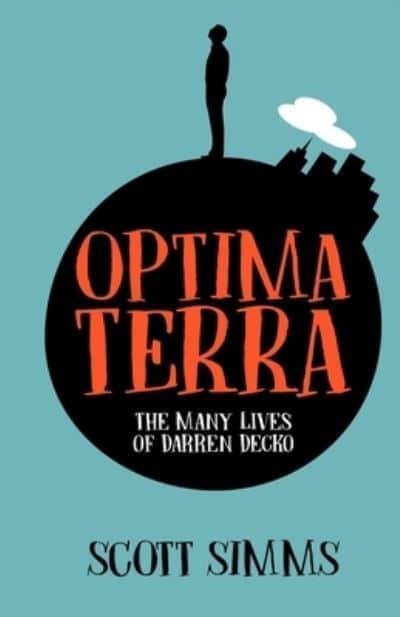
Optima Terra: The Many Lives Of Darren Decko - The Light Side Of Sci-Fi - Entertaining Dystopian/Utopian Story - You Decide

Optima Terra: The Many Lives of Darren Decko by Scott Simms

Optima Terra means Perfect World according to (Canadian?) author Scott Simms. The book is a light sci-fi tale that is both dystopian and utopian at the same time. Strange, right? Well, it is a strange story. I enjoyed this book and the adventures of Darren, the principal character, who finds himself in a myriad of bizarre situations.

What attracted me to this book was the cover - not because it was fancy, but because it was so minimalist in its design. The other element attracting my attention was the blurb - it just seemed like something I would enjoy.

The story opens with a seventeen-year-old Darren Decko in school. It spans his life through age twenty-six. During this time, Darren faces many challenges to him, both mentally and physically, while he strives to achieve the Gold status. The idea is to mount up points on his smart phone (or his "life card") through his performance on the jobs he is assigned. While in school, he meets the love of his life, a young woman named Rachel. In this highly regulated world, there are no guarantees people will see each other as they pass from one "Rotation" to another. A Rotation lasts 121 days. At the end of a rotation, all those except for skilled people - doctors, scientists, etc. - move from one place to another and perform different jobs or attend different schools as assigned by their life card.

Darren's life goal is to spend his life with Rachel, and he will do anything it takes to make that happen, including bringing down the Rotation System.

The story follows Darren for nine years of his life. He is a good person who is curious about the history of his world. He wants to understand the how and why of where he is. While he enjoys the benefits of the system, he is also dismayed by it because he does not know of his family. Family becomes very important to him as he gets hints about the world before the "New Era." When he meets Rachel, he wants to spend the rest of his life with her, but the system won't allow that. So, he decides the system needs to be changed. Darren is not the only one who wants change, there are many others who feel the same as he does. He decides the system need to be changed for everyone.

The key thing I enjoyed about the plot of this story was the elaborate and detailed world building by Simms. The plot unfolds through the backdrop of a world that provides everything people need to have a satisfying life within certain guidelines.

When a person finished school, they are sent into the workforce in the Rotation System. Everyone gets a new life every 121 days under the system. They are provided a place to live, complete with clothing, food, and an assigned job. Job assignments are sent to people on the first day of the new rotation. In one rotation, a person might be a garbage collector. In the next, they may find themselves a CEO of a major corporation. The training for these positions is provided while on the job, so it's a little stressful on the first days of an assignment.

Points are earned and awarded for adequate performance on the job, but points can also be taken away for poor performance or by committing an infraction of rules. Everyone is monitored by an army of flying robots - "bots" as they are referred to - and these bots may take points for rule infractions, failure to comply, or they may even hand out punishment.

Smart phones are vital to the citizens. They get information on their assignments on them as well as keep track of points on them. Phones are also a means of communication and work pretty much as they do for us today. One can store information, photos, locations of others on the devices, but they are wiped between rotations.

The world itself, Earth in the distant future, is a global community with no apparent government. There are no wars or conflicts, no environmental difficulties, and most people seem content with their situations. There are those who choose not to live within the system, and they are reduced to a low level of subsistence, barely squeaking out a living. Others not in the system have formed communities where they live an agrarian lifestyle that is difficult, but it is free.

A map of the planet is included at the front of the book to help one orient themselves as the story unfolds.

I'm not sure, but I think one of the themes the author wanted readers to think about is the dependance we have on technology in our world. Everything and everyone in Optima Terra is heavily reliant on tech. Everyone is monitored throughout their entire lives and the only thing that still seems private in life is one's own inner thoughts. As mentioned before, all the most basic necessities of life are provided for, but there is more to life than shelter and food. The society in this story has turned their lives over to the whatever power determines the rotations in the system. There are no long-term relationships on Optima Terra. Even how children are brought into existence is highly regulated. As I think about the world presented in this book, I know it is a place I would not want to live in. So, I think Simms is warning us to be careful to make sure technology remains a tool, and that we don't give up too much of our existence to it.

While the theme of machine control over humanity is usually framed as post-apocalyptic in most sci-fi, that is not the case in Optima Terra. This is a light sci-fi story meant to entertain more than frighten the reader and the writer did a good job incorporating humor in the text. Along with humor, there are many poignant moments, especially as Darren interacts with Rachel, and others important to him.

I recommend this story for those who want a relaxing read. It will be relaxing as long as one doesn't take it too seriously and think too deeply about it.

Scott Simms is a writer of urban fantasy and speculative fiction, preferring everyday situations with light sci-fi or fantasy elements introduced to an "everyman" or "everywoman."

I received an advance review copy of Terra Optima for free, and I am leaving this review voluntarily.

Well, there it is...

Qapla!